
The 7-Second Value Resume Framework: How to Make Your Resume Sell Your Professional Value
Meta Title: 7-Second Value Resume Framework: Make Your Resume Stand Out
Meta Description: Learn how to transform your resume, LinkedIn profile or freelancer profile from a list of skills into a powerful value proposition using the 7-Second Value Resume Framework.
"TLDR; Just Scroll to the End of the Page you will find an Infographic which Explains everything in Brief"
Your Resume Is Not a Biography
You may have spent years building your skills, collecting certifications, working on projects and gaining professional experience, but there is one uncomfortable truth about resumes that most people discover too late:
Companies don't pay you because you have skills. They pay you because your skills can solve problems that matter to them.
That distinction can completely change the way you approach your resume.
Most candidates write resumes as if they are documenting their professional history. They mention their education, list their skills, describe their responsibilities and add a few achievements at the end.
But recruiters and hiring managers are not reading your resume because they want to know your entire professional history.
They are trying to answer a much simpler question:
"Can this person solve the problem I am hiring for?"
And they are often trying to answer that question extremely quickly.
This is why a resume should not simply communicate information about you.
It should communicate your professional value.
That is the foundation of the 7-Second Value Resume Framework.
What Is the 7-Second Value Resume Framework?
The framework is designed to help job seekers, freelancers, consultants, entrepreneurs and professionals transform their profiles from a collection of skills into a clear value proposition.
The framework has five core components:
V - Value
A - Audience
L - Leverage
U - Uniqueness
E - Evidence
Together, they answer the five questions a potential employer or client subconsciously asks when looking at your profile:
What do you do?
Who do you help?
What problem can you solve?
Why should I choose you?
Can you prove it?
If your resume answers these questions clearly, you immediately become easier to understand and potentially more relevant to the opportunity.
V - Value: What Expensive Problem Can You Solve?
The first mistake people make is starting with themselves.
They write:
"I am a Digital Marketing Specialist with three years of experience."
That tells the recruiter what you call yourself.
It doesn't tell them why they should care.
Instead, start with the problem you solve.
For example:
"I help D2C brands reduce customer acquisition costs and generate more qualified leads through performance marketing."
Now there is a completely different mental response.
The reader can immediately understand the potential business value.
This is the first shift you need to make:
Stop asking, "What skills do I have?"
Start asking:
"What valuable problem can my skills help someone solve?"
Try completing this sentence:
I help [specific audience] solve [specific problem] through [your capability], resulting in [measurable outcome].
You don't necessarily need to use this exact sentence on your resume, but it forces you to think about your professional value correctly.
For example:
Weak:
Social Media Manager with 3 years of experience.
Stronger:
Helped consumer brands turn social media into a consistent source of qualified leads.
The second version creates curiosity because it talks about the result rather than simply announcing a job title.
A - Audience: Who Is Actually Reading Your Profile?
Your resume does not exist in isolation.
Someone is reading it.
And that person has a specific problem.
A startup founder looking for their first growth marketer is likely to evaluate candidates differently from the HR team of a large corporation.
A marketing head may care about revenue, acquisition and campaign performance.
A technical recruiter may care about specific technologies and project experience.
A client hiring a freelancer may care less about your job title and more about whether you can produce the outcome they need.
Therefore, before writing your resume, ask:
"Who has the power to say yes to me?"
Then understand what they actually want.
Ask yourself:
What problem are they hiring me to solve?
What outcome do they want?
Which skills are relevant to that outcome?
What would make them reject me?
What evidence would make them trust me?
This creates a simple chain:
Audience → Problem → Desired Outcome → Proof
Your resume becomes dramatically more effective when everything is written around this chain.
L - Leverage: Why Should Your Skills Matter?
Most resumes contain a long list of skills.
For example:
Photoshop
Canva
Google Ads
Excel
Communication
Leadership
Creativity
The problem is that tools and generic skills don't automatically communicate value.
Instead, organize your capabilities around outcomes.
For example:
Customer Acquisition
Performance marketing
Paid social
Landing page optimization
Conversion analysis
Growth
Lead generation
Funnel optimization
Campaign experimentation
Customer acquisition analysis
This changes the perception of your profile.
You are no longer simply saying:
"I know these tools."
You're communicating:
"I know how to use these capabilities to solve these problems."
That is leverage.
Your skills become valuable when they can be connected to an outcome someone actually cares about.
U - Uniqueness: Why You Instead of the Next 100 Applicants?
Being qualified isn't always enough.
There could be dozens or hundreds of people with similar degrees, job titles and skills.
So you need positioning.
Your uniqueness often comes from the intersection of:
Skill + Experience + Industry + Perspective
Consider these two statements:
"Marketing professional with eight years of experience."
versus:
"Growth marketer who has worked across early-stage startups and understands how to build customer acquisition systems when budgets are limited."
The second statement gives you a specific identity.
It tells the reader where your experience becomes particularly useful.
This is what positioning does.
You are no longer saying:
"I'm experienced."
You are saying:
"Here is the particular situation where I can be unusually useful."
That's a much stronger professional proposition.
E - Evidence: Don't Tell Them. Prove It.
This is arguably the most important part of the framework.
Anyone can write:
Excellent leadership skills.
Strong communication.
Creative problem solver.
Results-oriented professional.
Great team player.
The problem is that recruiters have seen these phrases thousands of times.
Instead, demonstrate the claim.
Use the formula:
Action → Problem → Result
For example:
Weak:
Managed social media campaigns.
Better:
Managed paid and organic campaigns across Instagram and Google, increasing qualified leads by 42%.
Even stronger, when the numbers are genuine:
Reduced cost per qualified lead by 31% while increasing monthly lead volume by 42%.
Now the reader has something concrete to evaluate.
Instead of asking them to believe you are good at your job, you're giving them evidence.
And evidence creates credibility.
The 7-Second Resume Test
Now comes the practical part.
Open your resume.
Look at it for approximately seven seconds.
Then close it.
Without looking again, answer these five questions:
1. What do I do?
2. Who do I help?
3. What problem do I solve?
4. What outcomes have I created?
5. Why should someone remember me?
If you cannot answer these questions quickly, your resume may have an information problem rather than a design problem.
You don't necessarily need another template.
You need better positioning.
A beautifully designed resume that communicates nothing valuable is still a weak resume.
The "So What?" Test
Here's another simple technique that can dramatically improve your resume.
After every major statement, ask:
"So what?"
Suppose your resume says:
"Managed a team of eight people."
So what?
What did the team accomplish?
You could rewrite it:
"Managed a team of eight that launched three products across two markets."
So what?
What happened because those products launched?
If you have legitimate numbers, continue:
"Managed a team of eight that launched three products across two markets, contributing ₹X in revenue."
You've now moved from:
Responsibility → Achievement → Business Impact
That is the transformation you want throughout your resume.
The Framework Works Beyond Resumes
The biggest advantage of this approach is that it isn't limited to job applications.
The same principle applies to your LinkedIn profile, portfolio, website, freelancer profile and even your personal brand.
Instead of:
Digital Marketer | MBA | Growth | Social Media | SEO
Try positioning yourself around the outcome:
Helping D2C brands turn digital marketing into predictable customer acquisition.
Now your profile immediately communicates what you are useful for.
Freelancers
Instead of:
I'm a video editor.
Try:
I help creators turn long-form videos into high-retention short-form content.
The client can immediately understand the potential outcome.
Consultants
Instead of:
Business consultant with 10 years of experience.
Try:
I help early-stage businesses identify revenue leaks and build scalable acquisition systems.
Again, you're moving from biography to value.
Your Resume Is a Sales Document
This doesn't mean you should exaggerate your achievements or turn your resume into aggressive sales copy.
It means you should understand what the document is actually trying to accomplish.
Your resume has one primary job:
Get the next conversation.
It doesn't need to tell your entire life story.
It needs to create enough relevance and credibility for someone to think:
"This person might be able to solve our problem. Let's talk."
That's it.
The interview is where you explain the depth of your experience.
The resume earns you the opportunity to have that conversation.
The Complete VALUE Framework
Before submitting your next resume or profile, run through this checklist.
V - Value
What expensive or important problem can I solve?
A - Audience
Who specifically needs this problem solved?
L - Leverage
Which capabilities allow me to solve it?
U - Uniqueness
Why am I particularly useful compared with other candidates?
E - Evidence
What measurable proof demonstrates that I can actually do it?
Then apply the 7-Second Test.
Can someone quickly understand:
Who you are → What you solve → Why you matter?
If yes, you're moving in the right direction.
The Biggest Shift You Can Make
Your resume shouldn't say:
"Here is everything I have done."
It should communicate:
"Here is the problem I understand, the capability I bring, and the evidence that I can create value."
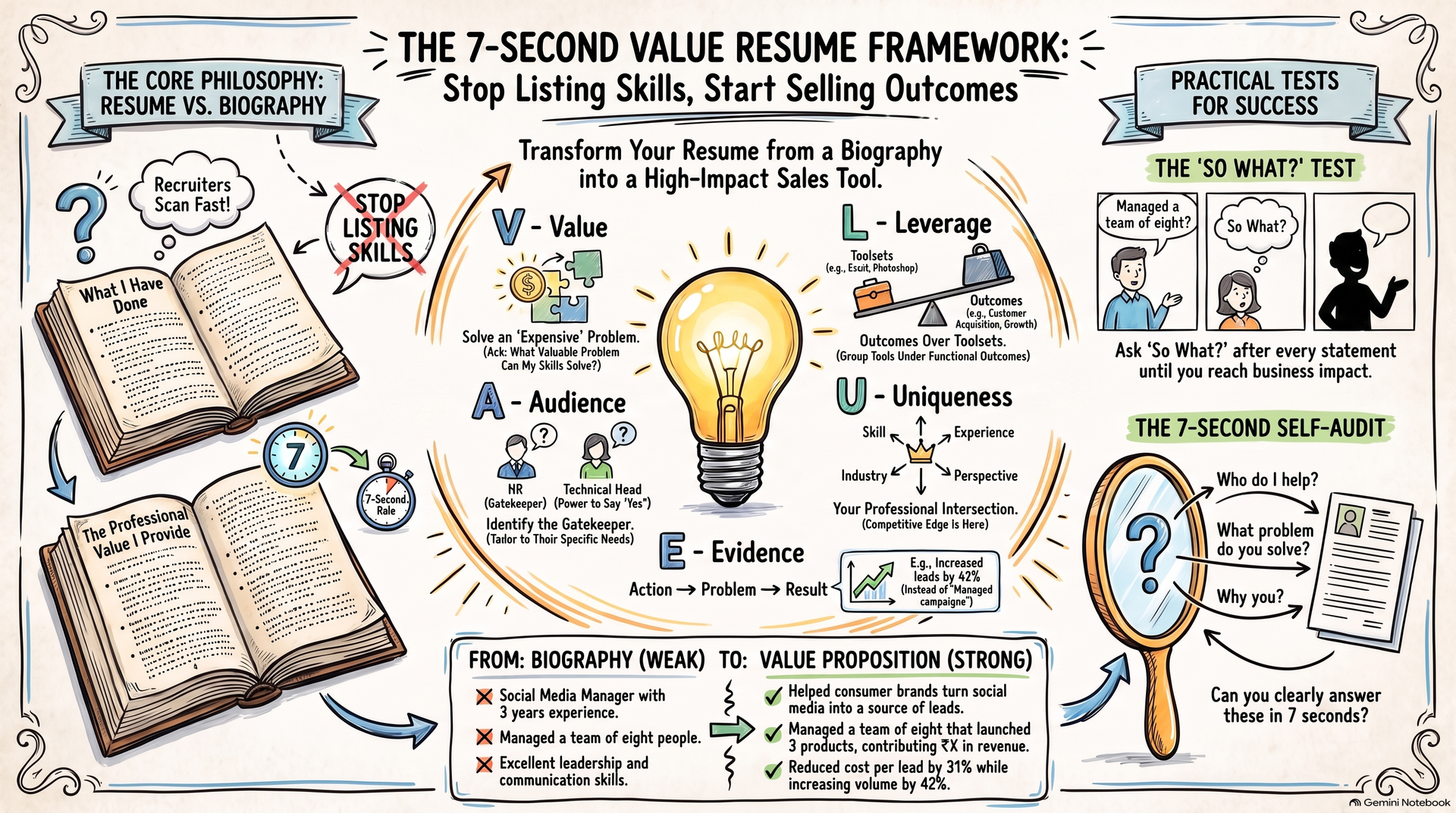
That's the difference between a resume that merely contains information and a profile that creates interest.
And this principle extends far beyond careers.
A freelancer is selling an outcome.
A consultant is selling an outcome.
A founder is selling an outcome.
A professional is selling an outcome.
Even a personal brand is ultimately communicating a reason for someone to pay attention.
Because people don't ultimately buy effort.
They buy outcomes.
So the next time you update your resume, don't begin by asking:
"What should I add?"
Start by asking:
"What should the person reading this believe about my ability to create value within seven seconds?"
That one question can completely change the way you present your career.
And remember:
Your resume is not your biography.
It is your professional value proposition.