
A degree can help you enter a room. But in the modern economy, what you can build, prove, distribute and automate increasingly determines what happens after you enter.
The opportunity today is unusual. A solo creator can reach millions. A freelancer in India can serve a company in London. A small D2C brand can compete with established players through social commerce. And AI can compress hours of research and production into minutes.
But technology alone doesn't create leverage.
You need a system.
TL;DR: SCROLL DOWN TO THE BOTTOM OF THE PAGE for INFOGRAPHIC
Here is a 10-rule framework for turning skills → proof → customers → systems → scalable income.
1. Start With a Painful Problem, Not a Skill
Don't begin with, "What skill should I learn?"
Begin with:
"Whose expensive problem can I solve?"
A designer shouldn't sell "graphic design." They could help D2C brands improve product-page conversion through better creative.
An AI consultant shouldn't sell "AI consulting." They could help recruitment firms automate candidate screening and reduce manual work.
Framework:
Problem → Person → Cost of Problem → Desired Outcome → Solution
The more expensive or urgent the problem, the easier it becomes to build a business around solving it.
2. Sell the Outcome, Not the Activity
Customers rarely care about how many hours you worked.
They care about what changed.
Instead of:
"I manage Instagram accounts."
Position the offer as:
"I build a content system that produces 20 qualified inbound leads every month."
Instead of "website development," think "a faster booking funnel for independent hotels."
This is outcome-based positioning.
Your offer should answer three questions:
What changes? For whom? By when?
3. Build a Narrow Beachhead
The internet rewards relevance.
Don't target "business owners."
Target something like:
Indian CA firms with 5–20 employees that want automated client acquisition.
Or:
D2C skincare brands doing ₹50 lakh–₹5 crore annually that need better retention.
A narrow market makes your messaging sharper, your learning faster and your referrals more relevant.
Once you dominate a small beachhead, expand sideways.
Beachhead → Adjacent niche → Category
That's often more powerful than trying to become everything to everyone.
4. Replace Credentials With Evidence
Credentials tell people what you studied.
Evidence shows what you can do.
Build Proof-of-Work Assets:
Before/after case studies
Live projects
Public experiments
Product prototypes
Data-backed results
Client testimonials
GitHub repositories
YouTube breakdowns
LinkedIn case studies
Industry-specific portfolios
For example, instead of claiming you understand AI automation, build an automated lead-qualification system and publish the workflow, results and lessons.
Your portfolio becomes your second resume.
5. Create a Distribution Engine
A great product nobody discovers is still invisible.
Modern builders therefore need distribution alongside production.
Choose one primary channel:
LinkedIn → B2B expertise
Instagram → Consumer attention
YouTube → Deep authority
X → Ideas and network effects
SEO → Long-term discovery
Then create a content loop:
Insight → Content → Attention → Trust → Conversation → Customer → Case Study → More Content
For example, an Indian AI automation consultant could publicly dissect one business workflow every week, demonstrate the automation, and convert interested viewers into consulting leads.
Don't just build a product.
Build the machine that brings people to it.
6. Turn Expertise Into a Repeatable Offer
Custom work feels entrepreneurial but can quickly become chaotic.
Productize what works.
For example:
AI Audit → Automation Blueprint → Implementation → Monthly Optimization
Instead of reinventing your service for every client, create standardized:
Deliverables
Pricing
Onboarding
Timelines
Templates
Reporting
Communication
Success metrics
This converts expertise into a repeatable business model.
7. Systemize Before You Scale
If every new customer creates more manual work, growth can become a trap.
Map the customer journey:
Lead → Qualification → Sales → Payment → Delivery → Follow-up → Referral
Then ask:
"Which step should never require my brain again?"
Automate repetitive tasks using tools such as CRM workflows, scheduling software, forms, email automation, AI agents and no-code integrations.
A small Indian recruitment agency, for example, could automate candidate intake, CV classification, interview scheduling and follow-up while humans handle relationship-building and final decisions.
The objective isn't to remove humans.
It's to remove unnecessary human effort.
8. Use AI as a Force Multiplier, Not a Substitute
AI shouldn't simply help you produce more content.
Use it across the entire operating system.
Research: summarize markets and competitors
Thinking: challenge assumptions and generate alternatives
Production: create drafts, designs and prototypes
Operations: automate repetitive workflows
Analysis: identify patterns in customer data
Sales: personalize outreach
Learning: create simulations and feedback loops
A solo founder can now operate with an "AI back office" covering research, documentation, analysis and repetitive execution.
But keep humans responsible for judgment, taste, relationships and accountability.
9. Build a Measurement Loop
Most people build once and hope.
Modern builders should operate experimentally.
Track a small set of numbers:
Attention → Leads → Conversion → Delivery → Retention → Profit
Suppose 10,000 people see your content.
If 200 visit your website, 40 enquire, 10 buy and 8 remain customers, you have a measurable system.
Now improve one bottleneck at a time.
This creates a powerful loop:
Measure → Diagnose → Experiment → Learn → Improve
Growth becomes less dependent on motivation and more dependent on feedback.
10. Turn the System Into an Asset
The final stage is moving from selling your time to building assets.
Your knowledge can become:
Templates
Courses
Software
Communities
Databases
Content libraries
Licensing
Subscription products
Digital products
Intellectual property
For example, a consultant who repeatedly solves the same logistics problem for Indian exporters could eventually turn the process into software, a subscription dashboard or a specialized data product.
That's leverage.
You solve the problem once, improve the system repeatedly, and allow the asset to create value beyond your individual hours.
The Modern Builder Roadmap
Don't try to implement all 10 rules simultaneously.
Use this sequence:
Phase 1 - Find
Week 1–2
Identify one customer segment and one painful problem.
Interview 10–20 potential customers.
Look for problems people already spend money solving.
Phase 2 - Prove
Week 3–4
Create a small solution.
Get your first users or customers.
Document the process and measurable outcome.
Your objective isn't perfection.
It's evidence.
Phase 3 - Package
Month 2
Turn the successful process into a standardized offer.
Create pricing, onboarding, delivery templates and a simple sales process.
Phase 4 - Distribute
Month 3
Choose one primary acquisition channel.
Publish useful content consistently.
Turn every successful project into another piece of proof.
Phase 5 - Automate
Month 4 onward
Track where your time goes.
Automate repetitive tasks.
Use AI for research, production, analysis and operations.
Then reinvest the time you recover into sales, product development and relationships.
Your Modern Builder Stack
You don't need 50 tools.
Start with a simple stack:
Research: Google, Perplexity or ChatGPT
Knowledge: Notion
Automation: Zapier or Make
CRM: HubSpot
Analytics: Google Analytics
Payments: Razorpay or Stripe
Communication: WhatsApp + email
Content: Canva + CapCut
AI: ChatGPT, Claude or Gemini
Proof: Website + LinkedIn + relevant portfolio platform
The tools will change.
The system shouldn't.
The Real Principle
The biggest shift isn't from degree to no degree.
It's from:
Knowledge → Application
Application → Proof
Proof → Trust
Trust → Customers
Customers → Systems
Systems → Leverage
Leverage → Assets
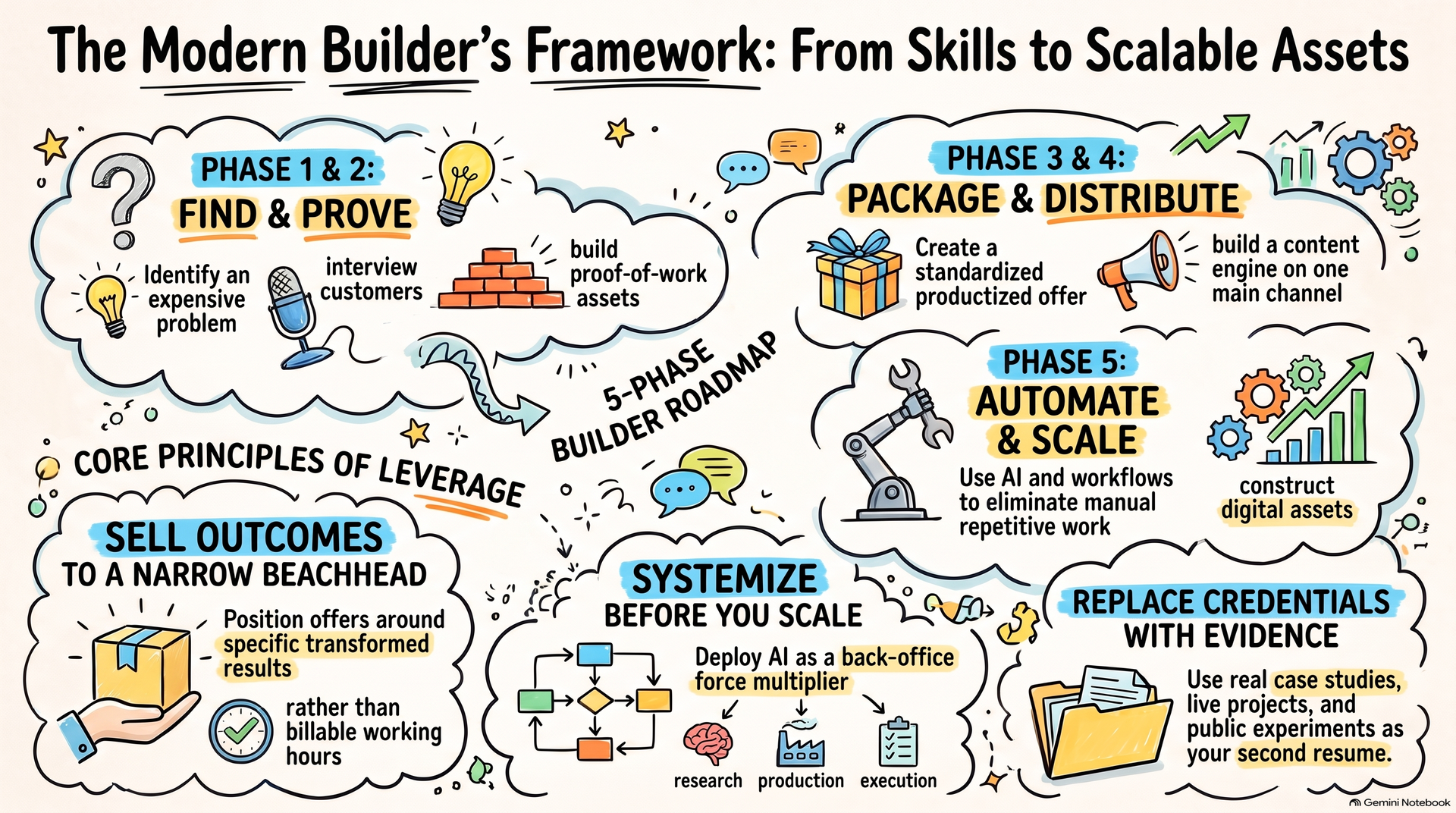
ROADMAP INFOGRAPHIC
That is the modern career-and-business flywheel.
You don't need to predict exactly what the economy will look like five years from now.
Build a system that can learn, adapt, prove value, acquire customers and improve faster than the environment changes.
That's the real leverage.
Start small. Solve something real. Prove it. Systemize it. Then scale it.