
Imagine two freelancers offering the same video editing service.
The first says, “I am a professional video editor who creates high-quality reels.”
The second says, “I help small businesses turn boring product videos into reels people actually want to watch.”
Same skill. Different story. And potentially, a very different customer response.
People don't just buy what you make. They buy what they believe your product can do for them.
That is the power of storytelling in marketing. From personal branding and startup marketing to product positioning and social media content, a compelling brand narrative can make an ordinary offering memorable.
TLDRL. Scroll down to the bottom of the page for free infographic
You don't need to be Elon Musk, run a billion-dollar company, or hire an expensive marketing agency. You need to understand how to turn your product, service, or project into a story people care about.
Here are 10 ways to do it.
1. Start With the Problem, Not the Product
Most businesses introduce themselves by explaining what they sell. Strong brands begin with the problem their audience wants solved.
Don't say, “We sell productivity software.”
Say, “Your team spends hours managing tasks instead of finishing them.”
The second message makes the audience recognise their own frustration.
How to apply it: Write down the three biggest problems your product solves. Use the most relatable one as the starting point for your website headline, pitch, reel, or advertisement.
2. Make Your Customer the Hero
Your customer should be the main character of your brand story, not your company.
A fitness coach isn't the hero because they know exercise science. Their customer is the hero who wants to feel stronger, healthier, and more confident.
Your role is to help them get there.
How to apply it: Describe your customer's life before using your product, the change they want, and how your offering helps them move forward.
For personal branding, position yourself as the person who helps others achieve something, rather than simply listing your qualifications.
3. Create a Clear Before-and-After Story
Transformation is one of the most powerful storytelling tools in marketing.
A resume writer doesn't merely format documents. They help job seekers communicate their experience more effectively.
A financial education creator doesn't just explain money. They help people make more informed financial decisions.
The difference is a clear picture of progress.
How to apply it: Complete this sentence:
“My audience goes from ______ to ______ with the help of my product, service, or expertise.”
Keep the transformation realistic. Promise what you can actually deliver, not guaranteed results you cannot control.
4. Give Your Brand a Belief
Memorable brands stand for something beyond their products.
A sustainable clothing brand might believe that looking good shouldn't require unnecessary waste. A career platform might believe that access to practical career knowledge shouldn't depend on privilege.
That belief becomes the foundation of its narrative.
How to apply it: Ask yourself, “What do I believe about this industry that influences how I work?”
Turn your answer into a simple brand statement. Your belief should shape your product decisions, content, customer experience, and communication.
5. Show the Enemy, Not a Fake Villain
Every compelling story has tension. In branding, that tension can be a frustrating habit, an outdated process, a misconception, or an inefficient system.
For example, a learning platform might challenge passive learning. A project management tool might challenge unnecessary meetings.
You don't need to attack competitors or manufacture controversy. Focus on the problem your audience wants to overcome.
How to apply it: Identify one common frustration in your industry. Build a campaign around how your product offers a better alternative.
6. Turn Features Into Meaningful Outcomes
Features explain what a product does. Outcomes explain why anyone should care.
A budgeting app has expense tracking. Its user wants greater visibility into where their money goes.
An AI design tool generates images. Its user may want to explore concepts faster or create initial drafts more efficiently.
How to apply it: For every feature, ask “So what?” until you reach a meaningful customer benefit.
For example: “Automated reminders” becomes “Fewer missed follow-ups, so your team can stay on top of important tasks.”
Be specific, relevant, and honest about the outcome.
7. Use Your Origin Story Strategically
Why did you start your business? What frustrated you? What did you notice that others overlooked?
Your origin story can make your brand feel human, especially when it explains why you care about solving a particular problem.
But your entire biography isn't automatically a marketing story. The relevant part connects your experience to the customer's needs.
How to apply it: Share the problem that inspired your project, what you learned, and how that lesson shaped your solution.
For a personal brand, this could become a LinkedIn post, an introduction video, or the opening section of your website.
8. Make Your Story Visual
A narrative doesn't have to be a long paragraph. It can be a product demonstration, a customer journey, a short video, or a simple comparison.
Show a messy workflow becoming organised. Demonstrate a complicated task becoming easier. Present a real project from its first draft to its final version.
Visual storytelling makes abstract benefits easier to understand.
How to apply it: Create a 30-second video using three scenes: the problem, your solution, and the result. Use genuine demonstrations and clearly distinguish real results from illustrations.
9. Build Proof Into the Narrative
A powerful story earns attention. Credible evidence earns trust.
Customer testimonials, product demonstrations, verified results, transparent case studies, and behind-the-scenes footage can support your claims.
Avoid fabricated testimonials, exaggerated statistics, or implying that one customer's experience is typical of everyone.
How to apply it: For each major promise, identify one piece of evidence that supports it. If you don't have evidence yet, demonstrate how the product works or invite people to test it.
Trust is part of your brand narrative, too.
10. Repeat One Consistent Message Everywhere
Your website, Instagram bio, advertisements, sales pitch, and LinkedIn profile should feel like parts of the same story.
If your website promises simplicity but your sales pitch focuses on technical complexity, your positioning becomes confusing.
Consistency helps people understand what you stand for and remember why you're different.
How to apply it: Write a one-sentence positioning statement:
“I help [specific audience] achieve [meaningful outcome] through [your product, service, or approach].”
Use it as your foundation. Adapt the wording for each platform, but preserve the core promise.
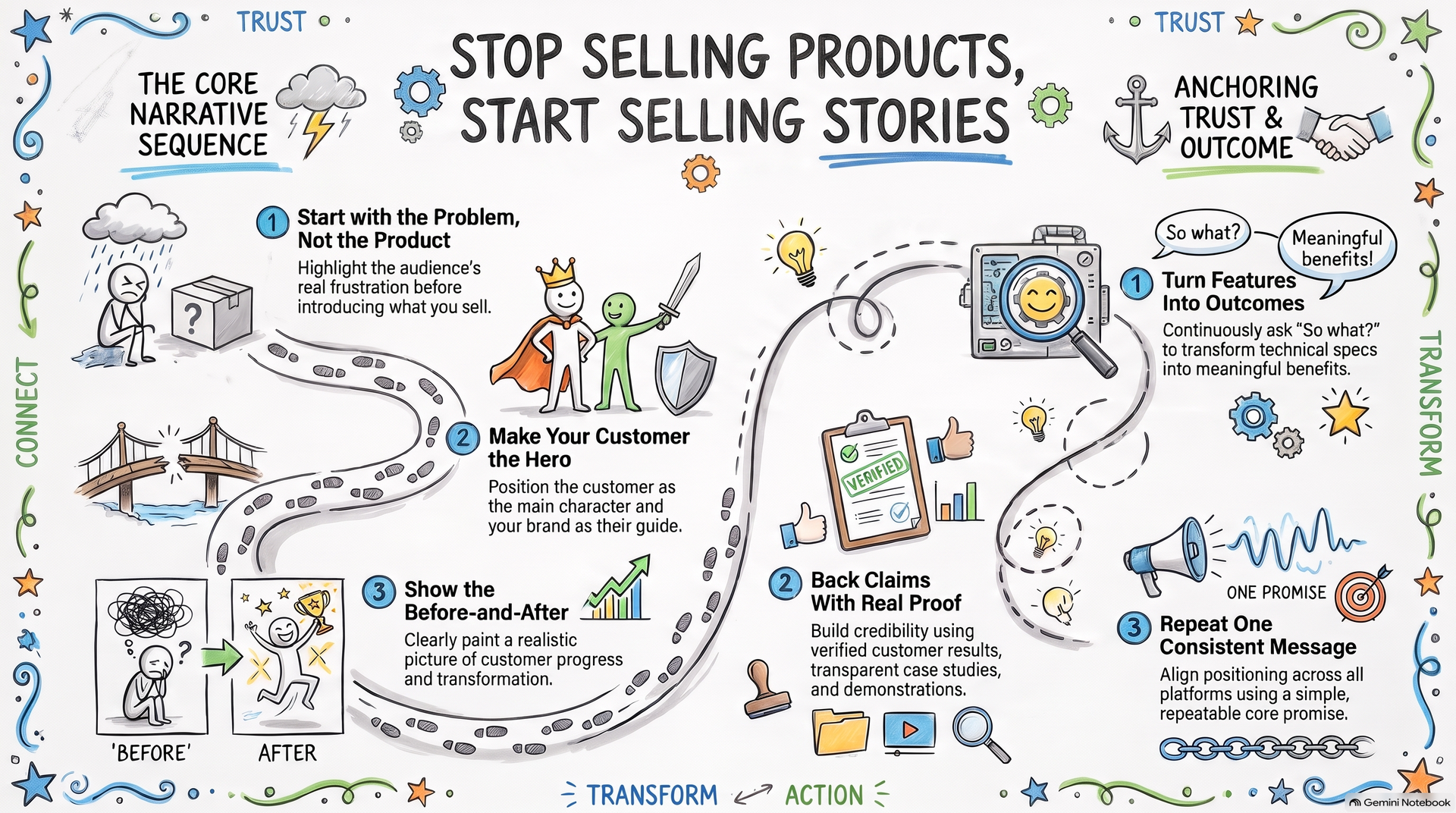
The Final Framework: Turn Your Product Into a Story
You can use these 10 principles to build a narrative for almost any product, service, startup, portfolio, or personal brand.
Remember this simple sequence:
Problem → Customer → Transformation → Belief → Solution → Proof
You don't need to invent a dramatic story. You need to make the real value of your work easier to understand, believe, and remember.
Your skill may get someone's attention. Your product may solve their problem. But the story connecting the two helps people understand why it matters.
Stop asking only, “What am I selling?” Start asking, “What change am I helping people create?”
That is where a more powerful brand narrative begins.