
Learn AI agents, agentic AI, AI automation, app connectors, context engineering and scheduled workflows with free courses and a practical 90-day roadmap. No coding experience required to get started.
Imagine starting your workday and finding your inbox summarized, important emails prioritized, research organized, and a daily report prepared automatically. You did not perform each task yourself. You built a system that handles the repetitive work for you.
That is the opportunity behind AI agents and intelligent automation.
In 2022, many people experienced AI primarily through chatbots. Later, AI tools became capable of generating code, presentations, images and documents. Now, AI agents can use tools, interact with connected applications and execute multistep workflows, depending on their permissions and configuration.
You do not need to become an AI researcher to participate in this shift. You need to understand how agents work, learn to connect them with useful tools, and build systems that solve real problems.
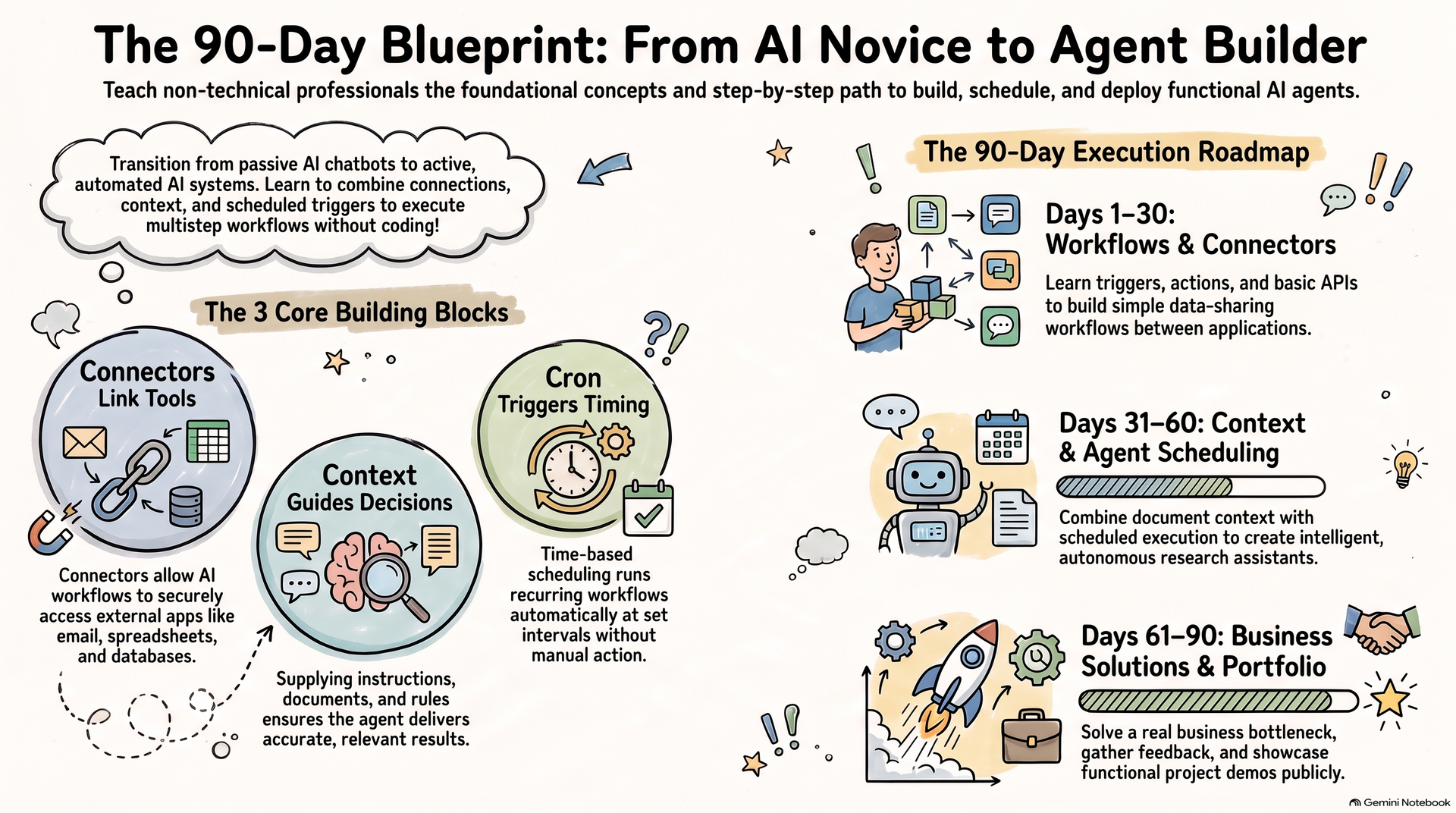
TL;DR Scroll down to the bottom of the page for Roadmap Infographic
Here is how to get started.
1. First, Understand What an AI Agent Actually Does
A chatbot primarily responds to your instructions. An AI agent can go further by selecting tools, taking actions, observing results and continuing through a task.
For example, instead of asking AI to explain your emails, you could build a workflow that retrieves permitted email data, summarizes important messages, identifies deadlines and prepares a daily briefing.
Three concepts help you understand this new way of working.
C1: Connectors
Connectors allow an AI workflow to interact with applications and services such as Gmail, Google Drive, calendars, spreadsheets and business software.
Your goal: Learn how to connect applications and move information between them securely.
C2: Context
Context is the relevant information an AI system uses to perform a task. It may include instructions, documents, previous interactions or business rules.
Your goal: Learn how to provide the right information so your agent produces relevant, accurate results.
Remember, an AI agent does not automatically know your entire history. It can access only the information available through its context, memory and authorized connections.
C3: Cron and Scheduling
Cron refers to time-based scheduling. It allows a supported workflow to run at specified intervals, such as every morning at 9 AM.
Your goal: Learn to create recurring workflows that run automatically and alert you when human attention is required.
Together, these skills help you move from simply using AI to building useful AI-powered systems.
2. Start With Free, Beginner-Friendly Learning Resources
Do not collect dozens of courses. Choose one primary learning path and build alongside it.
Here are three useful starting points.
1. n8n Academy: Learn AI Automation Without Starting With Code
Explore the free n8n Academy. Its courses cover workflow creation, triggers, application integrations, APIs, AI agents, testing and debugging. Its beginner quickstart also guides learners toward building a working AI agent without requiring prior coding experience.
2. Hugging Face Agents Course: Understand How Agents Work
Visit the Hugging Face AI Agents Course. It teaches agent fundamentals, tool use and frameworks such as smolagents, LangGraph and LlamaIndex. Some advanced exercises require basic Python and LLM knowledge, so begin with the introductory material.
3. Google AI Essentials: Build Your AI Foundation
Start with Google AI Essentials to understand practical generative AI usage, improve productivity and develop effective AI-assisted working habits. It is designed for learners without prior experience. Check the current enrolment terms for any course fee.
My recommendation: begin with n8n, study AI fundamentals alongside it, and move to the Hugging Face course once you understand basic agent workflows.
3. Your Free 90-Day AI Agent Roadmap
You do not need to master everything at once. Give yourself approximately 45–60 minutes daily, five or six days per week.
Days 1–15: Understand AI and Workflow Automation
Learn the difference between chatbots, workflows and agents. Understand triggers, actions, conditions, inputs and outputs.
Use n8n's beginner lessons to create simple workflows.
Build this: A scheduled workflow that runs at a chosen time and prepares a daily task summary from sample data.
Success milestone: You can explain what starts a workflow, what each step does and what happens when a step fails.
Days 16–30: Master Connectors
Learn how workflows exchange information between applications. Practise using Google Sheets, email services, forms and supported integrations.
Understand APIs, webhooks and authentication at a basic level. An API lets software communicate with another service; a webhook can notify a workflow when an event occurs.
Build this: A form-submission workflow that records a lead in a spreadsheet and prepares a personalized follow-up email for your approval.
Success milestone: Information moves between multiple tools without requiring you to copy and paste every field.
Use test accounts and dummy information while learning. Never expose passwords, API keys or private customer data.
Days 31–45: Learn Context and Reliable AI Outputs
An agent is only as useful as the information and instructions it receives.
Learn to provide clear goals, relevant documents, constraints, examples and output formats. Experiment with document retrieval and structured outputs.
Build this: A research assistant that answers questions using a small collection of documents and identifies the source supporting each answer.
Test it with questions whose answers are present, missing and ambiguous. Your system should acknowledge when the evidence is insufficient rather than inventing information.
Success milestone: You can improve the quality of an agent by changing its context, instructions and evaluation process.
Days 46–60: Add AI Agents and Scheduling
Now combine your skills.
Learn how an agent selects tools, handles multistep tasks and uses results from one action to decide what to do next. Explore scheduling, error handling, logs and human approval.
Build this: A daily research assistant that gathers information from permitted sources, summarizes findings and prepares a report at a scheduled time.
Keep consequential actions, such as sending external emails or modifying important records, behind human approval until you have tested the workflow thoroughly.
Success milestone: Your workflow runs on schedule, produces a useful result and reports errors instead of silently failing.
Days 61–75: Choose a Business Problem
This is where learning becomes commercially useful.
Pick one area you understand: marketing, recruitment, education, sales, finance operations or customer support.
Identify a repetitive task that consumes time or creates avoidable errors. Interview potential users, estimate the cost of the problem and build a small solution.
Examples include lead qualification, meeting preparation, customer-query classification and weekly performance reports.
Success milestone: At least one real person can test your system and explain whether it solves a meaningful problem.
Days 76–90: Build Your Portfolio and Find Opportunities
Create two or three polished projects. Record short demonstrations showing the original problem, your workflow, the output and the limitations.
Publish them on LinkedIn or a simple portfolio page. Explain the business result honestly, including time saved if you measured it.
Then approach small businesses, creators, agencies or professionals who experience the problem you solved.
Offer a small pilot project rather than claiming you can automate their entire business. Track reliability, corrections required and maintenance costs.
Success milestone: You have demonstrable projects, feedback from real users and a clear service you can offer.
4. How Can You Earn With AI Agent Skills?
Once you can build and maintain reliable workflows, consider these entry-level services:
AI workflow setup: Connect applications and automate repetitive administrative tasks.
Lead management: Organize incoming leads, classify enquiries and prepare follow-ups.
Research automation: Turn scattered information into structured reports.
Content operations: Organize research, drafts, approvals and publishing schedules.
Business reporting: Automate recurring spreadsheet summaries and performance reports.
You do not need to sell AI agents as a buzzword. Sell the outcome: fewer repetitive tasks, faster reporting, more consistent processes or better-organized leads.
Start with one niche and one clearly defined problem. Demonstrate the result before expanding your offer.
5. The Skills That Will Make You Valuable
Learning a tool is not enough. Tools change, and free tiers, integrations and features can change with them.
Build these durable capabilities:
Problem-solving: Identify which tasks are worth automating.
Workflow design: Break a process into clear, testable steps.
Context engineering: Supply relevant information and constraints.
Integration skills: Understand connectors, APIs and permissions.
Evaluation: Check accuracy, reliability and failure cases.
Business communication: Explain the value of your solution in plain language.
As you advance, learn basic Python and JSON. They will help you work with APIs, transform data and build more customized agents, although you can begin with visual automation tools.
Conclusion: Become the Person Who Knows How to Delegate to AI
The goal is not to use the highest number of AI tools. It is to build systems that reliably complete useful work.
Start with one workflow. Connect two applications. Add relevant context. Schedule a recurring task. Test it. Improve it. Then solve a real problem for someone else.
That is how you turn AI knowledge into practical skill, a portfolio and eventually a potential source of income.
Your 90-day challenge: Learn the fundamentals, build three projects and show your work publicly.
The future is not simply about humans competing against other humans. Increasingly, it will reward people who combine judgment, domain expertise and problem-solving with effective AI systems.
Start learning. Start building. Let the evidence speak for you.