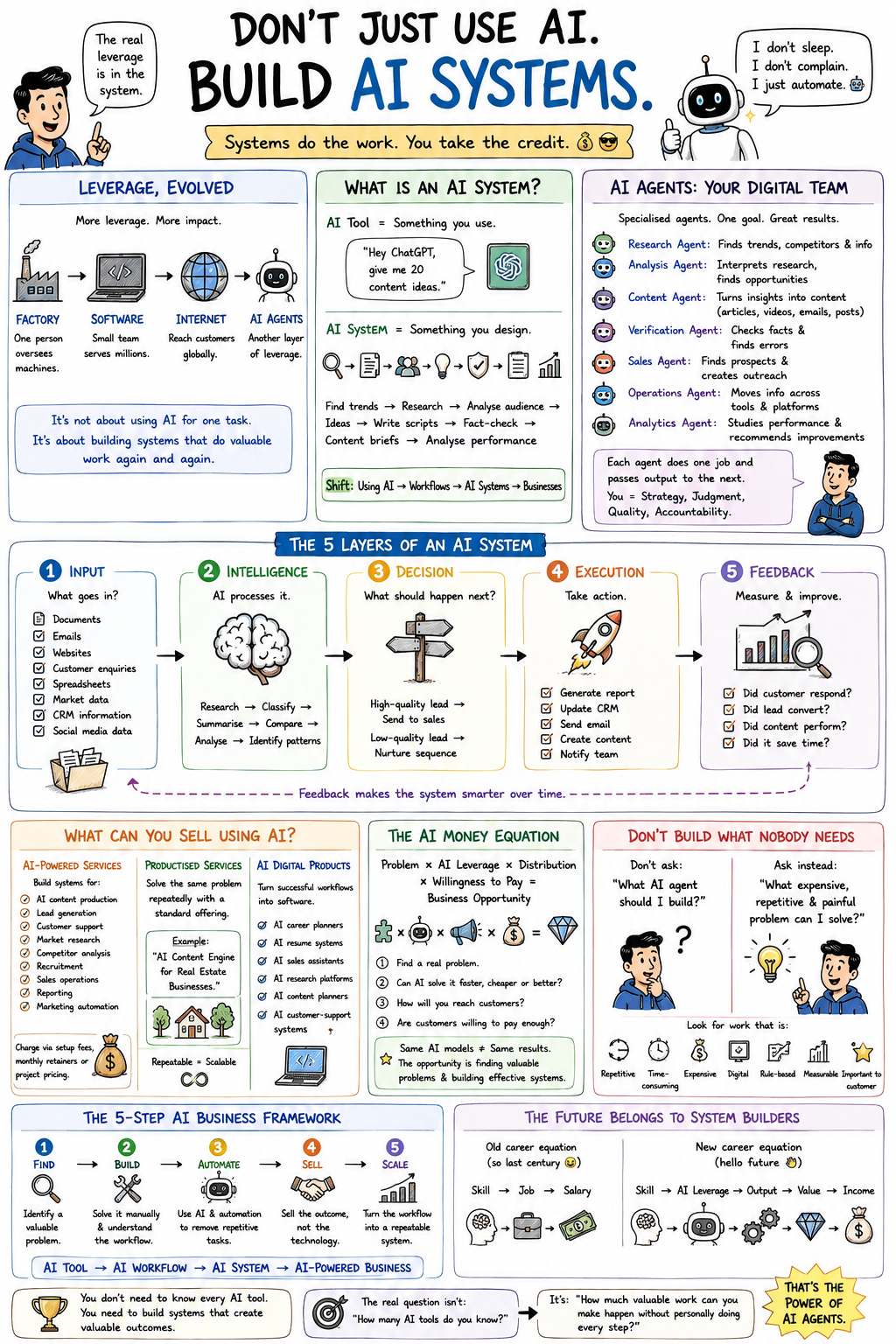
AI is no longer just a tool for writing emails, generating images or answering questions. The bigger opportunity is learning how to build AI-powered systems that can perform valuable work repeatedly - and potentially turn that work into income.
For decades, wealth creation has increasingly been connected to leverage.
A factory allowed one person to oversee machines that could produce thousands of products. Software allowed a small team to serve millions of users. The internet allowed individuals and businesses to reach customers globally.
Now, AI agents are creating another layer of leverage.
Instead of using AI to complete one task, you can connect multiple AI agents and automation tools into a system that can research, analyse, create, communicate and execute.
The opportunity isn't simply to "use AI."
It is to build systems with AI.
TLDR: SCROLL DOWN TO THE AI INFOGRAPHIC
What Is an AI System?
An AI tool is something you use.
An AI system is something you design.
For example, you could ask ChatGPT to generate 20 content ideas. That's using an AI tool.
But imagine a system that automatically:
finds trends → researches them → analyses your audience → generates ideas → writes scripts → fact-checks them → creates content briefs → analyses performance.
That's an AI-powered workflow.
The fundamental shift is from:
Using AI → Designing AI-powered workflows → Building AI systems → Creating businesses
The person who understands how to design these systems can potentially create far more output without increasing their workload proportionally.
How Do AI Agents Work Together?
Think of AI agents as specialised members of a digital team.
A business could potentially have:
- Research Agent: Finds market trends, competitors and relevant information.
- Analysis Agent: Interprets research and identifies opportunities.
- Content Agent: Converts insights into articles, videos, emails or social media posts.
- Verification Agent: Checks information and identifies errors.
- Sales Agent: Researches prospects and prepares personalised outreach.
- Operations Agent: Moves information between different software systems.
- Analytics Agent: Studies performance and recommends improvements.
You don't necessarily need dozens of agents.
The objective is to create a system where each component performs a specific job and passes its output to the next stage.
The human remains responsible for strategy, judgment, quality control and accountability.
How to Build Your Own AI Agent System
A practical AI automation system can be designed around five layers.
1. Input
Determine what information enters your system.
This could include:
- Documents
- Emails
- Websites
- Customer enquiries
- Spreadsheets
- Market data
- CRM information
- Social media data
2. Intelligence
AI processes the information.
It can:
research → classify → summarise → compare → analyse → identify patterns
3. Decision
Your system determines what should happen next.
For example:
A highly qualified lead could automatically be sent to sales, while a low-quality lead enters a nurture sequence.
4. Execution
The system takes action.
It could generate a report, update a CRM, prepare an email, create content or notify a team member.
5. Feedback
Finally, measure what happened.
Did the customer respond?
Did the lead convert?
Did the content perform?
Did the automation actually save time?
This feedback can then improve the system.
What Can You Sell Using AI?
Here's the important part.
Nobody pays you simply because you built an AI agent.
They pay because you solved a problem.
Instead of selling:
"We build AI agents."
You could sell:
"We build an AI system that helps your sales team identify and qualify prospects."
That distinction is critical.
AI-Powered Services
You can build systems for:
- AI content production
- Lead generation
- Customer support
- Market research
- Competitor analysis
- Recruitment
- Sales operations
- Reporting
- Marketing automation
You can charge clients through setup fees, monthly retainers or project-based pricing.
Productised AI Services
Once you solve the same problem repeatedly, turn it into a standardised offering.
For example:
"AI Content Engine for Real Estate Businesses."
Instead of building a completely different solution for every client, you create a repeatable system.
AI Digital Products
You can eventually convert a successful workflow into software.
Examples include:
- AI career planners
- AI resume systems
- AI sales assistants
- AI research platforms
- AI content planners
- AI customer-support systems
This is where scalability becomes particularly interesting.
The AI Money Equation
AI alone doesn't create a business.
A better framework is:
Problem × AI Leverage × Distribution × Willingness to Pay = Business Opportunity
First, find a real problem.
Then determine whether AI can solve it faster, cheaper or better.
Then figure out how you will reach customers.
Finally, determine whether those customers are willing to pay enough for the solution.
This is why having access to the same AI models doesn't mean everyone will make money from them.
The technology is increasingly becoming accessible. The ability to identify valuable problems and build effective systems around it is the opportunity.
Don't Build an AI System Nobody Needs
One of the biggest mistakes aspiring AI entrepreneurs make is starting with technology.
They ask:
"What AI agent should I build?"
Start somewhere else.
Ask:
"What expensive, repetitive and painful problem can I solve?"
Look for work that is:
- Repetitive
- Time-consuming
- Expensive
- Digital
- Rule-based
- Measurable
- Important to the customer
Then build the solution.
How to Start: The 5-Step AI Business Framework
You don't need to build a complicated multi-agent company on day one.
Start with:
1. FIND — Identify a valuable problem.
2. BUILD — Solve it manually and understand the workflow.
3. AUTOMATE — Use AI and automation to remove repetitive tasks.
4. SELL — Sell the outcome, not the technology.
5. SCALE — Turn the workflow into a repeatable system.
This is how you move from AI tool → AI workflow → AI system → AI-powered business.
The Future Belongs to System Builders
The biggest AI opportunity may not belong to the person who knows the most AI tools.
It may belong to the person who knows how to combine AI, automation, domain expertise and distribution to solve valuable problems.
The career equation is gradually changing from:
Skill → Job → Salary
towards:
Skill → AI Leverage → Output → Value → Income
You don't need to become an AI engineer to participate in this shift.
You need to learn how to identify problems, understand AI capabilities and build systems that produce valuable outcomes.
Because the question of the AI era isn't:
"How many AI tools do you know?"
It's:
"How much valuable work can you make happen without personally doing every step?"
That is the real power of AI agents.
And potentially, the beginning of a very different way of building businesses and income.