
The ADAPT Framework: A Step-by-Step Career Survival Guide for Indian Youth in the Age of AI and Automation
By Amit | Wiseversity
The future of work is not coming. It is already here - and most people are not paying attention.
Recent insights from Breakpoint: The Crisis of the Middle Class and the Future of Work by Saurabh Mukherjea and Nandita Rajhansa lay out a sobering picture: across industries, automation, AI systems, and efficiency-driven models are transforming traditional roles. Tasks that once required large teams are now being managed through centralised systems powered by technology. White-collar job creation is slowing. The importance of skills over degrees is rising. And the people who continue to rely only on traditional paths - degree, placement, stability - may find it harder to keep up every passing year.
The numbers make this uncomfortable to ignore. According to the Mercer-Mettl India Graduate Skill Index 2025, only 42.6% of Indian graduates are employable in today's digital economy. The WEF Future of Jobs Report 2025 warns that 39% of core job skills will change by 2030. IT giants like Infosys, TCS, and Wipro have significantly slowed bulk hiring. Campus offers at Tier-2 colleges are being deferred or withdrawn. India adds nearly one million new job seekers every month - but the economy is not absorbing them at that pace or at that quality.
This is not a reason to panic. It is a reason to adapt.
The old contract was: get a degree, get a job, get secure. That contract is broken. The new contract is: build skills, create value, stay adaptable, generate income.
This article introduces the ADAPT Framework - a milestone-based, execution-focused career resilience system designed specifically for Indian conditions. It is not motivational content. It is a practical, sequential system built to help you navigate the next decade of work - whether you are a fresh graduate, a working professional at risk of disruption, or someone who wants to build beyond a single income.
ADAPT stands for: Audit, Discover, Arm, Protect, Transcend.
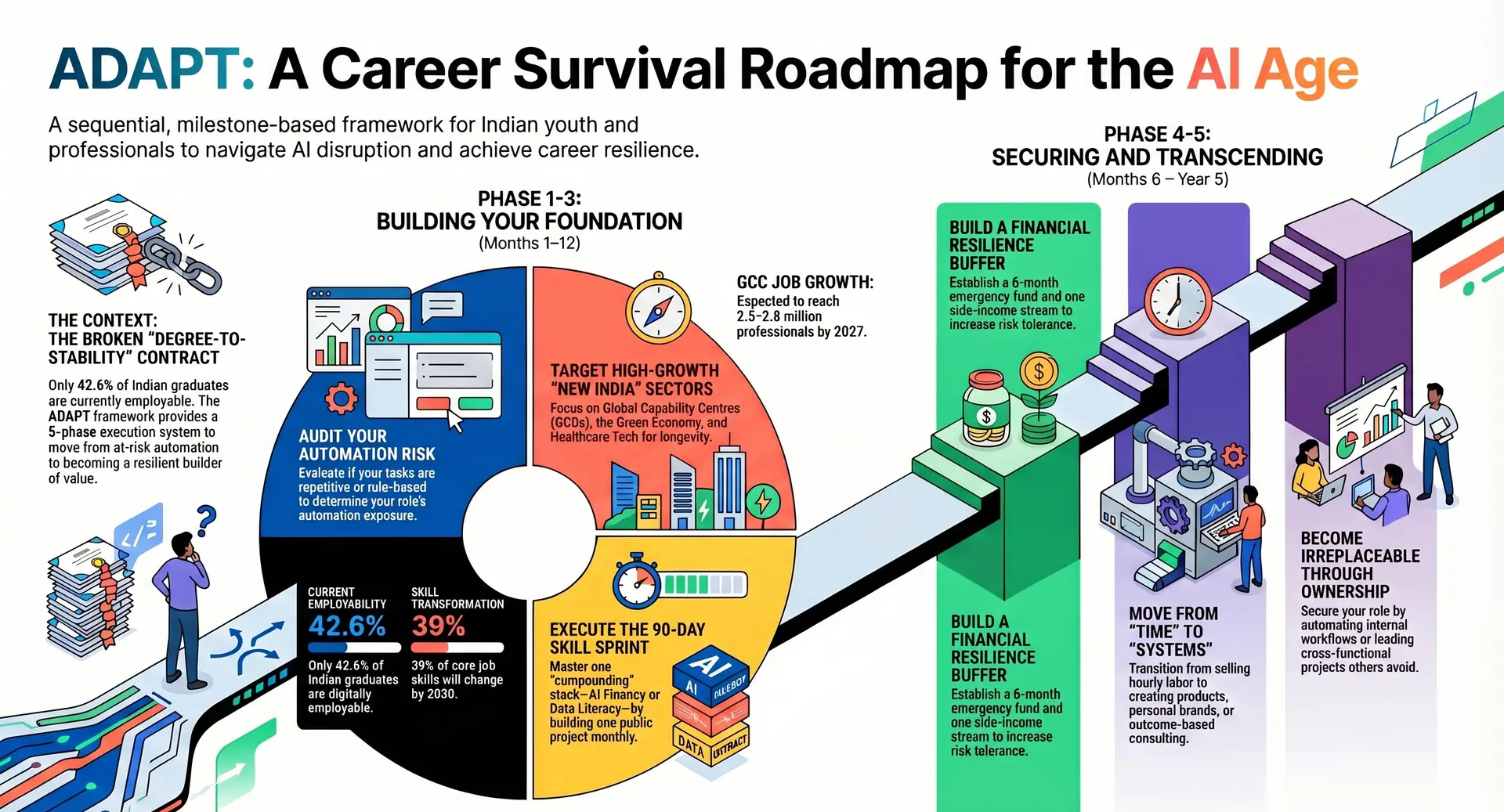
Let us go through each phase in detail.
Phase 1 - A: Audit Your Risk and Your Assets
Timeline: Months 1–2
Before you can move forward, you must see clearly where you stand. Most career advice skips this step and goes straight to "learn AI." But if you do not understand your actual exposure to disruption and your actual starting assets, you will spend time and money on the wrong things.
What to do in this phase
Run a Personal Automation Risk Assessment on your current or target role.
Not all jobs are equally at risk. According to research by economists at Northwestern University and MIT, generative AI represents a break from earlier automation trends - it now automates cognition itself. Entry-level accountants, coders, analysts, content writers, customer service executives, and paralegals are all watching algorithms absorb their daily tasks.
Ask yourself honestly: Is my work primarily repetitive and rule-based? Do I spend most of my day processing documents, answering queries, entering data, generating standard reports, or doing tasks that follow a script? If yes, your role has a high automation exposure. This does not mean your job disappears tomorrow. It means the number of people needed to do your job will shrink - and the people who survive will be those who add judgment, creativity, and contextual intelligence on top of the technical baseline.
Example: A junior financial analyst who spends 80% of their time pulling data and building standard Excel reports is highly exposed. A senior analyst who uses that data to make strategic recommendations, communicate with clients, and build proprietary models is far less exposed - even though both have the same job title.
Conduct a T-shaped skills gap audit.
Draw a T on paper. The vertical bar represents deep expertise in one domain. The horizontal bar represents working knowledge across adjacent areas. Most Indian graduates have a narrow I-shape - one deep but isolated skill. The market now rewards T-shaped or even π-shaped professionals who combine depth with versatility.
Example: A Python developer who also understands business metrics, can communicate technical work clearly to non-technical stakeholders, and knows how to use AI tools to accelerate their own workflow is dramatically more valuable than one who only codes.
Map your financial runway honestly.
How many months can you sustain yourself without income? This single number determines everything about how aggressively or conservatively you need to move. Most Indian households operate on a month-to-month basis. If your runway is under three months, you cannot afford to quit and reskill full time. You need a parallel track strategy - learning while earning. If your runway is over six months, you have more flexibility.
Identify your hidden assets.
Many youth undervalue what they already have. Regional language fluency - Hindi, Tamil, Marathi, Bengali, Telugu - combined with English is a significant advantage in vernacular content, Tier-2 B2B sales, and local market consulting that global AI tools cannot yet serve. Your existing network, sector-specific knowledge, geography, and even your family's business context are assets that can be leveraged. Document them.
The audit deliverables
By the end of Phase 1, you should have: a role automation risk score (high, medium, or low), a T-shaped skills map with gaps marked, a financial runway number in months, and a list of your non-obvious assets.
Phase 2 - D: Discover Where Real Opportunity Lives
Timeline: Months 2–4
Once you know where you stand, the next step is to stop looking at the job market you were sold and start understanding the job market that actually exists. These are different things.
The six high-growth sectors in India right now
Global Capability Centres (GCCs): Companies like JP Morgan, Goldman Sachs, Apple, Google, and hundreds of mid-sized global firms now run major R&D, product, AI, and finance operations from India. GCCs employed 1.9 million professionals as of 2024 and are expected to grow to 2.5–2.8 million by 2027. Critically, these are no longer back-office support roles. They are now engineering, strategy, data science, and product management positions. Getting into a GCC today positions you at the frontier of global work - at Indian living costs.
Green Economy: India's government has committed to massive investment in renewables, EVs, and sustainable infrastructure. By 2030, the green economy is expected to generate 3 million new jobs in areas like renewable energy installation, EV manufacturing and servicing, sustainability consulting, and environmental compliance. These are fields with almost no existing talent pool. Early movers have an extraordinary advantage.
Healthcare Technology: India's healthcare sector is growing at 7–10% annually. Digital health, telemedicine, medical AI, health records management, and health insurance technology are all creating new roles that did not exist five years ago.
Agri-Tech: India has 140 million farming households. Precision agriculture, supply chain optimisation, crop advisory platforms, and rural fintech are all underserved. Companies building in this space are scaling rapidly and hiring people with a mix of domain knowledge and technical skills.
Ed-Tech and Skill-Tech: Despite the bust-and-rebuild cycle, education technology addressing real learning outcomes - particularly professional upskilling and vernacular learning - continues to grow. Platforms targeting Tier-2 and Tier-3 India are especially active.
Defense Manufacturing under PLI: India's Production Linked Incentive schemes are directing significant capital into domestic manufacturing. Companies like Tata, L&T, and new-age defense startups are hiring engineers, supply chain professionals, and project managers at scale.
The Tier-2 and Tier-3 city arbitrage
This is one of the most underused career advantages in India today. Companies like Zepto, Meesho, and dozens of GCCs are actively building in cities like Indore, Coimbatore, Jaipur, Nagpur, and Bhubaneswar. The cost of living in these cities is 40–60% lower than Mumbai or Bengaluru. Competition for quality talent is 5–10 times less.
Example: A ₹50,000 salary in Mumbai translates to roughly ₹30,000 in Nagpur in purchasing power - but the Nagpur talent pool competing for that role is far smaller. A sharp professional in Nagpur with strong skills and digital visibility can get opportunities that would take years to crack in Mumbai.
The adjacency pivot
One of the most practical and underused career tools is the adjacency pivot - identifying roles one skill-step away from your current track that are growing.
Example 1: A content writer who understands SEO can become an AI-prompt specialist or content strategist. The pivot requires learning two to three new tools and frameworks - roughly three months of focused effort.
Example 2: A BPO executive with analytical instincts can become a data annotation team lead or a process automation coordinator. Companies building AI systems desperately need people who understand both the business process and the technology layer.
Example 3: An HR generalist who learns people analytics, ATS management, and employer branding strategy becomes a sought-after talent acquisition lead in a GCC or startup context.
The 10-informational-interview rule
Before applying to any new role or investing in any new certification, do this: have real conversations with 10 professionals who are actually thriving in the roles you are targeting. Not your college seniors. Not random LinkedIn connections. Actual practitioners.
These conversations will tell you more than any job description or course syllabus: what skills actually matter, what is overrated, what doors open from specific companies, what the culture looks like, and what they wish they had known earlier.
Most Indian youth talk only to peers and professors. The people who move fastest talk to practitioners.
Phase 3 - A: Arm Yourself with Compounding Skills
Timeline: Months 3–12
This is where most career advice begins. It should not. Skills without direction are wasted effort. But now that you know your risk profile and your target terrain, you can invest in the right skills with precision.
The key principle of this phase is that skills must compound - each one should build on the others and multiply your value. Isolated certificates do not compound. Integrated capability does.
Here are the four skill stacks that will matter most for Indian professionals in the next decade.
Skill Stack 1 - AI Fluency (Not Engineering)
You do not need to build AI. You need to work effectively with it.
The single biggest career divide emerging right now is between professionals who use AI tools to do more in less time and those who do not. An analyst who uses AI to process reports, generate first drafts, clean data, and automate research is doing the work of three people. That person becomes indispensable. The person who refuses to engage with these tools becomes redundant.
Practical AI fluency includes: prompt engineering (getting high-quality outputs from tools like Claude, ChatGPT, and Gemini), AI tool orchestration (knowing which tool to use for which task), no-code and low-code automation (using tools like Zapier, Make, or n8n to automate repetitive workflows), and basic understanding of what AI can and cannot do reliably.
Example: A legal assistant who learns to use AI for document review, contract summarisation, and clause comparison can handle twice the workload with half the time investment. They become a more productive professional, not a displaced one.
Free learning path: Google's AI Essentials course → DeepLearning.AI short courses on Coursera → build three real projects using AI tools in your own domain. Timeline: 8–10 weeks of one hour per day.
Skill Stack 2 - Data Literacy
The ability to read, interpret, and communicate with data is the most universally valuable professional skill of the decade. This does not mean becoming a data scientist. It means being able to look at a spreadsheet, understand what the numbers are telling you, build a basic analysis, and communicate the insight clearly.
The progression: Excel (advanced functions, pivot tables) → SQL basics (querying databases without coding expertise) → a visualisation tool like Power BI or Tableau → storytelling with data (presenting insights in a way that drives decisions).
Example: A marketing executive who can pull their own campaign analytics from Google Analytics, build a performance dashboard in Looker Studio, and present data-backed recommendations to their leadership becomes a dramatically more valuable team member than one who waits for the analytics team to send reports.
Free learning path: YouTube channels like Alex the Analyst or Chandoo → Kaggle's free SQL and data analysis courses → build a portfolio project using publicly available Indian data (SEBI, RBI, census, or government data portals). Timeline: 10–14 weeks.
Skill Stack 3 - Communication and Critical Thinking
This is India's most underestimated career gap. Employers in GCCs and MNCs consistently cite structured communication, clear writing, and second-order thinking as the biggest missing skills in Indian candidates - even those with strong technical backgrounds.
Critical thinking is the ability to break complex problems into parts, question assumptions, weigh evidence, and arrive at sound conclusions. Structured communication is the ability to express those conclusions clearly, whether in writing or in speech, for different audiences.
These skills do not come from a single course. They come from practice. Write regularly. Solve case studies. Debate ideas. Present your thinking to others. Join communities where intellectual rigor is expected.
Example: Two engineers both have similar Python skills. One can explain their system design clearly in a document, present trade-offs to a product manager, and write a concise status update that their manager trusts. The other cannot. The first gets promoted. This plays out across every industry and every level.
Practical path: Structured writing practice (one piece per week on any professional topic) → Toastmasters or similar public speaking practice → Coursera's Critical Thinking specialisation → read one serious non-fiction book per month and write a one-page summary.
Skill Stack 4 - Financial and Business Literacy
Understanding how businesses make money, how to read a P&L, what ROI means, how to price your own value, and how to make decisions under uncertainty - these are the skills that separate those who get promoted from those who plateau.
Most Indian educational institutions produce technically competent graduates who have no understanding of business fundamentals. This creates an enormous gap. The professional who understands both the technical and business dimensions of their work is rare - and extremely valuable.
Example: A product manager who can read the company's quarterly P&L, understand how their product's performance contributes to gross margin, and make prioritisation decisions based on financial impact is a significantly more effective professional than one who thinks only in terms of features and user stories.
Free learning path: Zerodha Varsity (free, excellent) for personal finance fundamentals → HBS Online CORe for business fundamentals → one business book per month (recommended: The Almanack of Naval Ravikant, Zero to One, The Hard Thing About Hard Things, Atomic Habits).
The 90-day skill sprint rule
Do not try to learn all four stacks simultaneously. Follow this system: pick one skill, learn for one focused hour per day, build one real project within 30 days, publish it publicly, and apply it in your current role or freelance work. Then move to the next skill. This creates compounding capability, not a collection of incomplete certificates.
Phase 4 - P: Protect Your Income and Build Resilience
Timeline: Months 6–18
This is the phase most career frameworks ignore. Skills and ambition mean nothing if a single job loss or a single bad month can financially destabilise you. India does not have the social safety nets of Western economies. Displacement here can push families back into informality. Financial resilience is not a luxury - it is the foundation that makes everything else possible.
Milestone 1 - Build a 6-month emergency fund
Before any investment, before any side hustle, before any career pivot - build a financial buffer. Even ₹50,000 to ₹1,00,000 in a liquid fund (not a savings account - use a liquid mutual fund for better returns while keeping instant accessibility) gives you the psychological runway to take calculated risks without desperation.
The SIP habit matters more than the amount at first. Start with ₹500 per month if that is all you can manage. The discipline of consistent saving retrains your relationship with money and creates momentum.
Milestone 2 - Develop at least one income stream outside your primary job
This is not about getting a second job. It is about monetising a skill in a way that gives you income without requiring a full-time commitment.
The Indian gig economy is expected to employ 24 million people by 2030. Platforms and channels exist for nearly every skill set. The goal in this phase is not to build a business - it is to generate ₹5,000 to ₹20,000 per month from a source that is not your employer. That amount can cover one month of basic expenses. That changes your negotiating position in your job, your confidence, and your risk tolerance.
Examples of income streams suited to Indian professionals:
- Online tutoring on platforms like Vedantu, Unacademy, or independently via WhatsApp groups (₹5,000–₹30,000/month for subject matter experts)
- Freelance writing or content creation for LinkedIn, newsletters, or brand blogs (₹10,000–₹50,000/month for consistent writers with a clear niche)
- Social media management for local SMEs - most small businesses in India have no digital presence and will pay ₹8,000–₹25,000/month for someone to manage their Instagram and Google Business profile
- Campus placement consulting - if you recently cracked a competitive placement, freshers in your college will pay for guidance
- Digital product sales - templates, guides, mini-courses sold through Gumroad or Instamojo (passive income once built)
Milestone 3 - Make yourself irreplaceable at your current organisation
The fastest way to job security is not a new certification. It is solving a real, visible problem your organisation has that others are avoiding.
Take ownership of one process improvement initiative. Automate one workflow that currently takes manual effort. Lead one cross-functional project. Write one internal guide that becomes the team's reference document. Become the person your manager thinks of when something needs to get done right.
Visibility combined with consistent execution is the most reliable protection against being the first name on a layoff list.
Milestone 4 - Build basic financial literacy and act on it
Most Indian professionals earning ₹30,000 to ₹80,000 per month are leaving significant money on the table through poor financial decisions - not maximising 80C deductions, not having term insurance, not covering health risk with adequate insurance, not investing even a small amount systematically.
A financially literate 25-year-old with modest income and disciplined habits will build more wealth over a career than a financially illiterate 35-year-old with a higher salary. The compounding advantage of starting early is enormous in a country with India's long-term growth trajectory.
Minimum financial hygiene checklist: term insurance of 10x annual income by age 28, health insurance of at least ₹5 lakhs (separate from employer-provided cover), SIP into an index fund or diversified equity fund, full utilisation of 80C deduction, and an emergency fund in a liquid fund.
Phase 5 - T: Transcend - From Employee to Creator to Builder
Timeline: Year 2–5
Most career advice stops at job security. But the people who will build extraordinary lives in the next decade will not just protect their employment - they will transcend it. Transcendence is the shift from selling your time to creating systems that generate value beyond your direct effort.
This is the long game. It requires patience, consistency, and the willingness to invest in things that do not pay off immediately. But the compounding returns are unlike anything a job can provide.
Milestone 1 - Build a personal brand that documents your expertise publicly
A personal brand is not about followers or fame. It is about compounding credibility. A professional who writes about their domain consistently - on LinkedIn, a newsletter, YouTube, or a podcast - for two years becomes a recognised authority. That credibility opens doors that no resume can.
In India, this is dramatically underdeveloped. Most Indian professionals are invisible online. Their expertise exists only in their heads and their employer's systems. This means the early movers who build a public presence have outsized advantage.
Example: An HR professional in Pune who starts writing weekly LinkedIn posts about talent acquisition trends, hiring strategies for Indian startups, and compensation benchmarks will, within 12–18 months, receive inbound messages from founders and investors who need exactly that expertise. That person transitions from an employee to a consultant or advisor without ever actively looking for clients.
The practical approach: pick one platform, post one piece of content per week on your specific professional domain, be consistent for 90 days, and measure what happens.
Milestone 2 - Transition from selling time to selling outcomes and systems
There is a hierarchy of how professionals generate income. At the base, employees sell their time for a fixed monthly salary. Freelancers sell their time plus their skill - more flexibility, but still time-bound. Consultants sell outcomes - they are paid for results, not hours, which allows for higher rates and better leverage. Creators and product builders sell systems - things that generate income without their hourly presence.
The goal of the Transcend phase is to move at least one level up this hierarchy. This does not require quitting your job. It can happen in parallel.
Example: A chartered accountant moves from being an employee at a firm (selling time) to freelance tax consulting for small businesses (selling skill + time) to building a subscription-based tax compliance tool for kirana stores (selling a system). Each step multiplies their income per hour worked.
Milestone 3 - Identify one deep problem you can solve better than anyone in your context
India has thousands of niche, high-value problems that global products do not serve. GST compliance is complicated for small businesses. Agricultural advisory is unavailable in most regional languages. HR software designed for the Indian SME context barely exists. Rural logistics has massive inefficiency. Healthcare navigation for non-English speakers is broken.
You do not need a billion-dollar idea. You need a ₹10-crore idea with 100 real paying users. The founder who solves a genuine pain point for a defined Indian market - even a small one - creates more lasting value and income than most corporate careers ever will.
Milestone 4 - Build something that outlasts your direct effort
The highest form of career resilience is creating something - a team, a community, a product, a body of knowledge - that continues to generate value without requiring your hourly presence. This is the difference between a career and a legacy.
For most people, this means: building a team that can execute without you, building a community around your expertise that compounds over time, building a product or course that sells while you sleep, or mentoring others in a way that multiplies your impact beyond your own hours.
Bonus: The India Edge - Advantages Most Youth Overlook
India is not just a market where disruption happens to you. It is a platform from which you can build extraordinary careers and businesses. Here are four structural advantages that most Indian youth do not fully appreciate.
The GCC Opportunity
Global Capability Centres have quietly transformed the Indian career landscape. These are not call centres. Companies like JP Morgan, Goldman Sachs, American Express, Apple, and hundreds of mid-sized global firms now run genuine R&D, AI, product, and strategic finance operations from India. The talent they need is locally available but in short supply - especially people with strong technical foundations combined with communication skills and business understanding.
Getting into a GCC puts you at the frontier of global work. You build skills, earn well, and develop a global network - all while living in India.
The Demographic Dividend and Remote Work Arbitrage
65% of India's population is under 35. The world's oldest economies - Japan, Germany, South Korea, the United States - are facing talent shortages and desperately need young, English-speaking, technically trained professionals. Remote work has made this accessible in a way it never was before.
An Indian professional earning $40,000 USD remotely for a US or European company earns the equivalent of ₹33 lakhs per year - a senior manager salary at a Mumbai MNC - while potentially living anywhere in India at dramatically lower costs. The compounding wealth-building potential of this arbitrage is extraordinary.
The Bharat Market
Over 700 million people are being connected to the digital economy for the first time. UPI has transformed payments. JioPhone and affordable data have connected rural India to the internet. ONDC is democratising e-commerce. The Aadhaar-based identity stack is enabling financial services at scale.
The founders of companies that successfully serve first-time digital users in India - through vernacular AI tools, voice-first applications, rural fintech, healthcare navigation, agricultural advisory - are sitting on one of the largest untapped consumer opportunities in human history.
Government Tailwinds
India's government is directing capital at scale into manufacturing through PLI schemes, into AI infrastructure through the IndiaAI Mission, into startups through DPIIT, and into skills through PMKVY 4.0. These are not programs to enroll in as a box-ticking exercise. They are signals of where capital and jobs will flow over the next decade.
Aligning your career trajectory with these capital flows - getting deep expertise in semiconductor manufacturing, clean energy, AI infrastructure, or advanced manufacturing - puts the wind at your back.
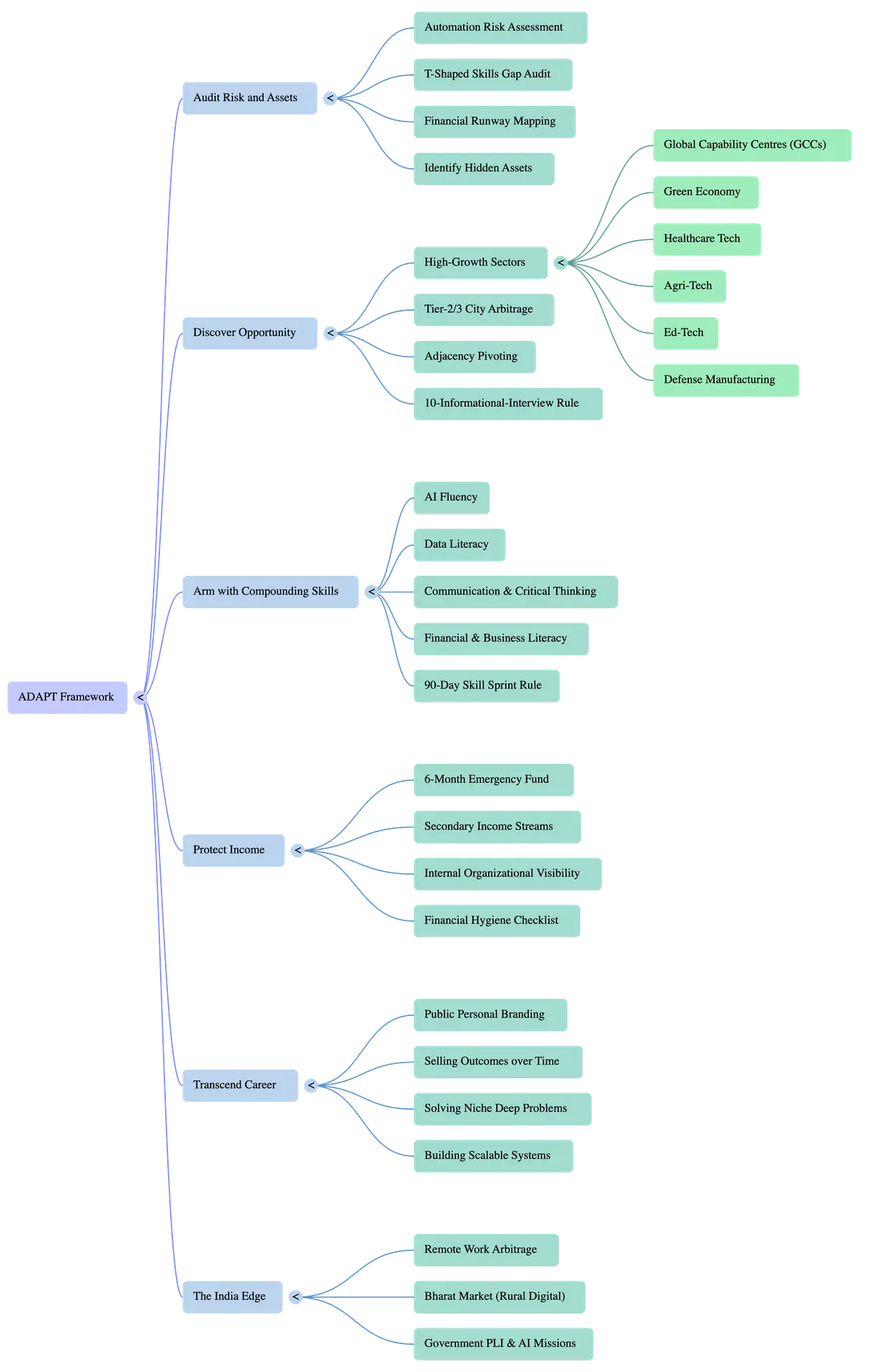
Putting It All Together: Your ADAPT Roadmap
Here is what the full framework looks like as a practical timeline for a typical Indian graduate or young professional:
Months 1–2 (Audit): Run your automation risk assessment, complete your T-skills gap map, calculate your financial runway, document your hidden assets.
Months 2–4 (Discover): Research three high-growth sectors relevant to your background, identify your adjacency pivot options, map your target companies, conduct 10 informational interviews.
Months 3–12 (Arm): Begin your first 90-day skill sprint. Start with AI fluency or data literacy depending on your role. Build real projects. Then add the next stack.
Months 6–18 (Protect): Start your emergency fund SIP. Launch your first side income experiment. Take one visible leadership initiative at your current organisation. Set up term insurance and health cover.
Year 2–5 (Transcend): Start publishing your expertise publicly. Build your first consulting engagement or digital product. Identify the deep problem you want to solve. Begin building systems that outlast your direct effort.
Roadmap
Final Thought
The next phase of economic growth in India will not reward qualifications alone. It will reward adaptability and execution.
The degree on your wall was the entry ticket to the last economy. The skills in your hands, the value you create, and the systems you build are the currency of the next one.
You are not competing with AI. You are competing with the version of yourself who either adapted or did not. The ADAPT Framework exists to make sure you are the one who did.
Start with the audit. Everything else follows.
Amit is a career & skills development expert, entrepreneur, and co-founder of Wiseversity - a platform dedicated to helping professionals build future-ready high-income careers. He is also the co-author of Unhooked, Networked, and Career Hero.
© Wiseversity / Cryonix LLC. All rights reserved.