
Architecting a Defensible Startup: The Founder’s Roadmap for the AI EraIn the pre-AI era, launching a software product followed a predictable playbook: write clean code, build an intuitive user interface, and out-market the competition.
Today, the playbook is broken. Generative AI has dropped the cost of writing code to near zero. A competitor can screenshot your app, feed it to an LLM, and replicate your entire frontend and basic backend architecture over a weekend. If your only differentiator is "features," your application is fundamentally defenseless.
To survive the AI transition and build a lasting business, you need an economic moat - a structural barrier that protects your business from competitors. This roadmap outlines how to strategically inject defensibility into your project from pre-launch to scale, ensuring your application remains secure against both human rivals and AI-driven commoditization.
TLDRL. Scroll down to the bottom of the page for free infographic
Phase 1: The Pre-Launch Foundation (Zero to Blueprint) Before a single line of code is written, you must architect the structural defenses of your application. Trying to bolt a moat onto an existing, easily replicable product later is incredibly difficult.
1. Secure Proprietary Data & Build Data Flywheels AI models are heavily commoditized; the data used to fine-tune them is where the value lies.
- The Strategy: Identify unique, unreplicable data that you can legally collect, which competitors cannot scrape from the public web.
- Execution: Design loops where user interactions continuously generate data. More users generate more data, which refines your custom algorithms, making the app smarter, which in turn attracts more users (e.g., TikTok's recommendation engine).
2. Aim for System of Record (SoR) Positioning Apps that act as superficial "workflows" are easily replaced by AI agents. Apps that own the underlying data infrastructure are not.
- The Strategy: Position your application to become the single, definitive source of truth for a specific type of critical data.
- Execution: Ensure your app houses the core database where vital information lives (e.g., QuickBooks for financial data, Jira for project tracking). A user might use an AI agent to change their peripheral tools, but they will rarely allow it to rip out their core system of record.
Phase 2: Tech Stack & Product Architecture (The Build) How you build determines how easily you can be copied. Focus on deep engineering rather than simple API integrations.
3. Develop Technical & Intellectual Property (IP) Moats If your application is just a thin visual wrapper around OpenAI or Anthropic APIs, you do not own a software company—you own a distribution channel for someone else’s AI.
- The Strategy: Develop proprietary algorithms, custom-trained models, or deeply complex backend architectures that require significant R&D to copy.
- Execution: Solve highly technical, domain-specific engineering problems. Build custom fine-tuned models or hybrid architectures that blend traditional software determinism with AI probabilistic outputs.
4. Optimize for Cost Advantage & Operational Scale Running AI infrastructure is incredibly expensive. The founder who can deliver the same AI intelligence at a fraction of the compute cost wins.
- The Strategy: Establish the structural capability to deliver your service at a lower operational cost than competitors.
- Execution: Optimize your inference pipelines, utilize open-source models (like Llama models) hosted on specialized hardware, or implement edge-computing strategies. High margins allow you to out-spend rivals on customer acquisition or aggressively undercut them on price.
Phase 3: Go-To-Market & Growth (The Launch) A secure app means nothing if no one knows it exists. Use the product architecture itself to drive organic, low-cost growth.
5. Integrate Embedded Viral Loops In the AI era, ad networks are flooded with AI-generated marketing, driving customer acquisition costs (CAC) through the roof. Your product must market itself.
- The Strategy: Design product features that inherently force or incentivize users to invite others to get value.
- Execution: Build collaborative, multiplayer features where the tool is useless alone but powerful together (e.g., Figma files, DocuSign links, or shared interactive dashboards). When a user shares your app’s output, they act as a high-converting acquisition channel.
6. Lock In Exclusive Distribution Channels: Sometimes the best defense is simply owning the digital real estate where your customers live.
- The Strategy: Secure exclusive partnerships or distribution networks that systematically block rivals from reaching your audience.
- Execution: Form strategic alignments with legacy enterprise software aggregators, negotiate pre-installation agreements on specific hardware, or secure exclusive integrations into industry-standard legacy platforms.
Phase 4: Scaling & Retention (Post-Launch Defensibility): Once you gain traction, the goal shifts from acquisition to retention. You must make it friction-heavy for users to leave.
7. Engineer High Switching Costs Retention is the ultimate metric of startup health. If your users can leave instantly, you have a leaking bucket, not a business.
- The Strategy: Make it too expensive, time-consuming, or operationally disruptive for a customer to migrate to a competitor.
- Execution: Embed your app deeply into the user’s daily workflow. Integrate heavily via custom APIs with their other software tools. Enterprise SaaS giants like Salesforce excel at this; even if a cheaper competitor emerges, the human cost of migrating data and retraining an entire staff creates a massive barrier to exit.
8. Activate Network Effects (Direct & Indirect) The holy grail of business defensibility: a product that scales its value automatically with its user base.
- The Strategy: Ensure your platform becomes exponentially more valuable to existing users as new users join the ecosystem.
- Execution: Build two-sided marketplaces (like Airbnb or Uber) or true interaction networks. The more nodes (users, buyers, developers) that enter the network, the more utility every existing node receives, making it virtually impossible for an upstart competitor to match your value proposition.
Phase 5: The Ultimate Moat (Long-Term Survival) As your product matures, your technical edges will naturally narrow. Your final defenses are human and community-driven,
9. Build Community and Ecosystem Moats People can copy your code, but they cannot copy your community.
- The Strategy: Surround your app with a vibrant ecosystem of third-party developers, creators, and advocates.
- Execution: Launch a public API marketplace, an open plug-in framework, or templates created by users (e.g., WordPress, Notion templates, or Apple’s Developer Ecosystem). By allowing external developers to make a living off your platform, you enlist an army to defend your market share.
10. Cultivate Brand and Trust Equity In a world saturated with AI hallucinations, deepfakes, and automated spam, human trust is the scarcest commodity in technology.
- The Strategy: Establish a brand that commands emotional attachment, top-of-mind awareness, and absolute security trust.
- Execution: Prioritize flawless user experience, absolute data privacy transparency, and a consistent public voice. Users will willingly pay a premium to a brand they trust (like Apple or Stripe) over a generic, cheaper AI wrapper because trust removes psychological risk.
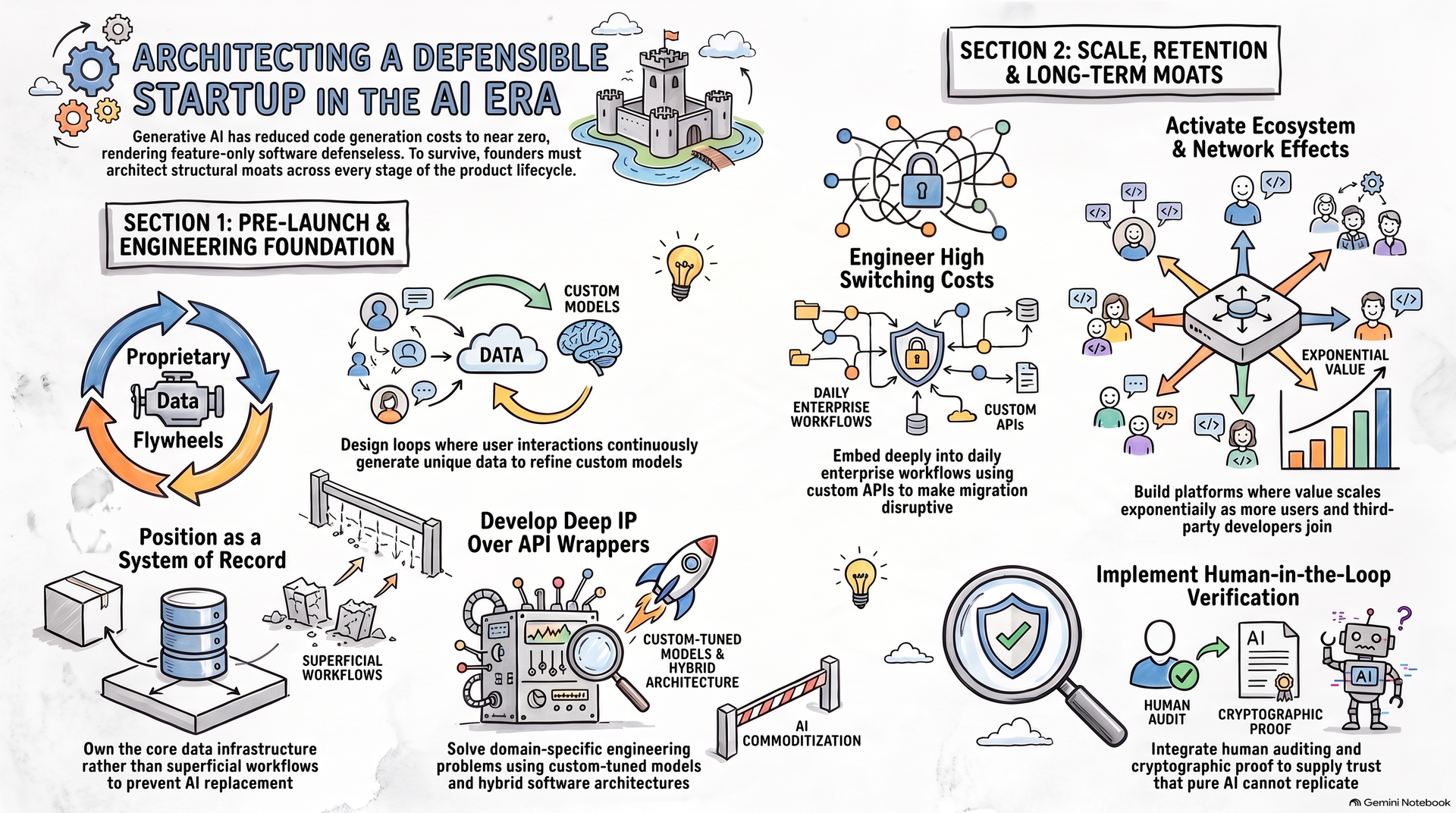
The AI Counter-Strategy: The "Human-in-the-Loop" Verification Moat, To truly future-proof your application against advanced AI models that can reason and automate workflows, you must implement the ultimate AI counter-strategy: The Human-in-the-Loop (HITL) Verification Moat. As AI agents increasingly take over digital tasks, the internet will face a crisis of authenticity. AI can generate text, code, and synthetic data, but it cannot provide real-world human validation, physical accountability, or verified domain expertise.
[ AI Automation Layer ] ──> Fast, Cheap, Scalable Execution
         │
         ▼
[ Your App's HITL Moat ] ──> Human Auditing, Cryptographic Proof, Trusted Compliance
         │
         ▼
[ Defensible Value ]    ──> Bulletproof Trust that Pure AI Cannot Replicate
How to Implement It:
- The "Proof of Humanity" Layer: Build cryptographic or identity-verification protocols directly into your app. Ensure that the most critical actions on your platform require verifiable human consensus or biometric proof.
- Domain Expert Auditing: Position your app not just as an automated AI generation tool, but as an auditing and compliance platform. For instance, if your app generates legal contracts or medical notes via AI, your moat is a built-in network of vetted human lawyers or doctors who verify the output with a single click.
The Golden Rule for the Future: Don't just build an application that uses AI. Build the application that verifies, secures, and structures the mess that AI creates. That is a moat no algorithm can cross.