What if you could use AI to start earning online without becoming a programmer, investing thousands of rupees, or spending years learning complicated technical skills?
Today, AI tools can help people write content, edit videos, automate repetitive work, create websites, and deliver digital services to businesses worldwide. The opportunity is not simply to use AI. It is to use AI to solve a problem someone is willing to pay for.
In this guide, you will discover eight practical AI income streams, how to get started, and a simple 30-day roadmap to pursue your first remote client.
TLDR: Scroll down to the bottom of the page.
1. AI Content Writing and Copywriting
Businesses need website content, blog posts, product descriptions, email newsletters, and social media captions.
Use tools like ChatGPT to research topics, create outlines, and develop first drafts. Your job is to improve the output, verify facts, and make the writing relevant to the client's audience.
How to earn: Offer a monthly content package to small businesses, coaches, agencies, or online stores.
2. AI-Powered Video Editing
Creators and businesses need short videos for Instagram Reels, YouTube Shorts, and LinkedIn.
Tools like Descript and Canva can simplify editing, captions, and visual creation.
How to earn: Offer packages that turn a long podcast or interview into several short videos. Focus on strong hooks, clean editing, and audience retention rather than simply producing more clips.
3. AI Social Media Management
Many small businesses struggle to publish consistently. You can use AI to plan content calendars, generate post ideas, draft captions, and repurpose existing content.
How to earn: Sell a monthly package that includes content planning, captions, basic creatives, scheduling, and performance reporting. Your value comes from understanding the client's audience and improving results, not just generating posts.
4. No-Code AI Automation Services
This is one of the most interesting opportunities for people who enjoy solving business problems.
Imagine a business receiving enquiries through a form. An automation could organize the information, add it to a spreadsheet or customer management system, and send a notification to the sales team.
Tools such as n8n, Zapier, and Make help connect different applications.
How to earn: Build simple automations that save businesses time. Start with one repetitive task, test it thoroughly, and charge for setup and ongoing maintenance.
You can learn through the free, hands-on courses at n8n Academy.
5. AI Website and Landing Page Creation
Small businesses often need a website, booking page, or landing page but do not have an in-house developer.
AI website builders and coding assistants can help you create an initial version without writing every line of code yourself.
How to earn: Build simple websites for consultants, local businesses, creators, or service providers. Charge for the project and offer optional monthly maintenance.
You still need to check mobile compatibility, forms, security, performance, and whether the website actually works.
6. AI Research and Virtual Assistance
Entrepreneurs spend hours organizing information, preparing reports, researching competitors, managing documents, and handling routine administrative tasks.
AI can help summarize information, organize spreadsheets, draft correspondence, and prepare research reports.
How to earn: Offer remote virtual assistance or research support to founders, consultants, recruiters, and small teams.
Accuracy and confidentiality matter. Verify important findings and never upload a client's sensitive information into a tool without appropriate permission.
7. Sell Digital Products Created With AI
Instead of selling your time repeatedly, create a digital product that can be sold multiple times.
Examples include:
Resume templates and job-search planners
Notion templates and productivity systems
Industry-specific prompt packs
Small business checklists and guides
Educational workbooks and digital downloads
Use AI to help with research, drafting, and organization, then add your own expertise and test the finished product.
How to earn: Sell through platforms such as Gumroad or your own website. Remember that creating a product does not guarantee sales. You also need distribution, useful content, and a clear reason for customers to buy.
8. AI Training and Consulting for Small Businesses
Many business owners have heard about AI but do not know where to begin.
You could help a shop owner use AI for product descriptions, teach a consultant to create better presentations, or help a small team automate repetitive tasks.
How to earn: Start with a paid one-to-one session or practical workshop. Once you understand the common problems, package your knowledge into training sessions, templates, or recurring support.
You do not need to be an AI scientist. You do need to understand the tools you teach, explain their limitations, and demonstrate useful results.
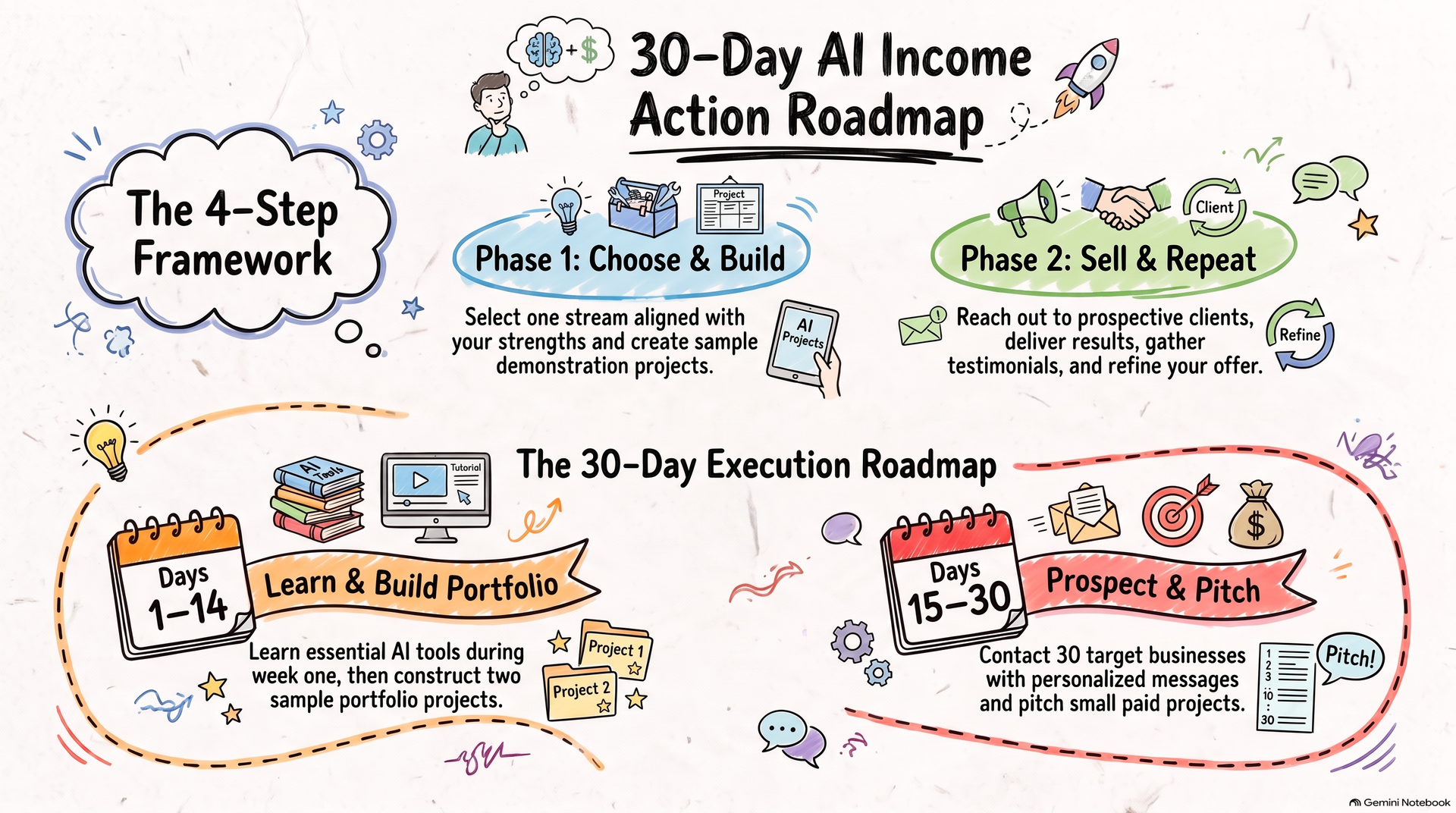
The Simple Framework: Choose, Build, Sell, Repeat
Trying all eight ideas at once is a mistake. Use this four-step framework instead.
Choose: Pick one service that matches your existing strengths and interests. If you write well, start with content. If you enjoy systems, explore automation.
Build: Create two or three sample projects that demonstrate what you can deliver. You can use fictional businesses for demonstrations, clearly labelling the work as a sample.
Sell: Identify a specific customer group and contact potential clients through LinkedIn, freelance marketplaces, professional communities, or direct outreach.
Repeat: Deliver a good result, request feedback, collect a testimonial with permission, and improve your offer. Once you have repeat customers, consider monthly retainers or digital products.
Your 30-Day Roadmap to Remote Income
Days 1 to 7: Learn one skill. Choose one income stream and learn the basic tools. Free resources such as Zapier Academy can help beginners explore automation and AI workflows.
Days 8 to 14: Build your portfolio. Create two sample projects and document the problem each one solves.
Days 15 to 21: Find prospects. Make a list of 30 relevant businesses or potential clients. Contact them with a personalized message explaining how you could help.
Days 22 to 30: Pitch a small paid project. Offer a clear deliverable, timeline, and price. Follow up professionally and use feedback to refine your offer.
Your first month may produce a client, valuable conversations, or simply a better understanding of the market. Income is not guaranteed, so avoid expensive courses or subscriptions before validating demand.
Final Thoughts
The future of remote work is not about knowing every AI tool. It is about combining useful skills, AI assistance, and an understanding of real customer problems.
Choose one income stream, build something useful, and start conversations with potential buyers. Once you have evidence that people will pay for your work, build a repeatable service and expand carefully.
Don't chase eight income streams. Build one that works, then use AI to make it better.