
The future of work isn't simply going to reward people who know the most.
It will increasingly reward people who can use technology, make better decisions, build trust, create opportunities and convert value into outcomes.
AI is already changing how information is discovered, how work gets executed and how businesses operate. But that doesn't mean humans suddenly become irrelevant.
Quite the opposite.
The premium may move toward people who can direct AI rather than compete with it.
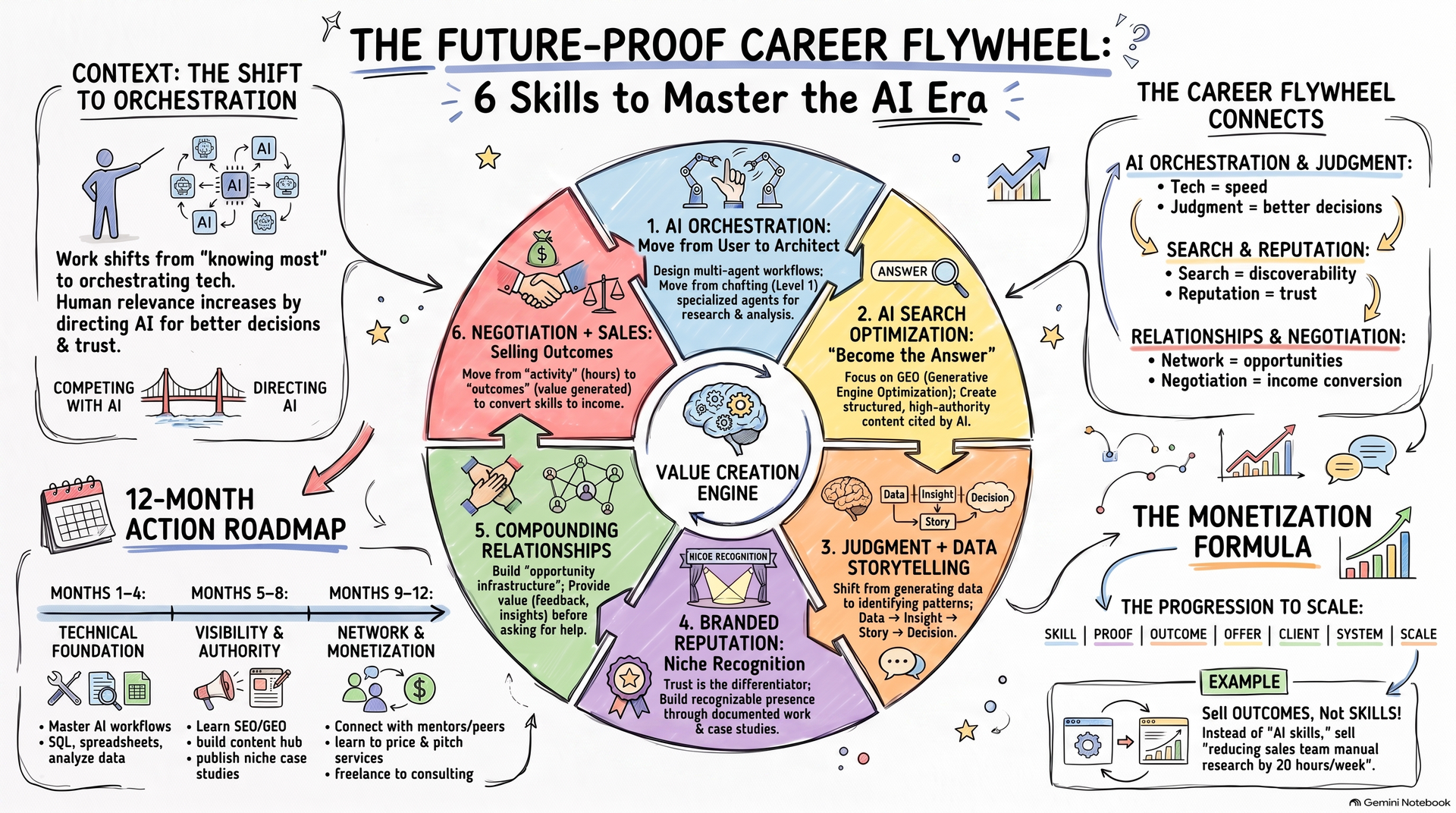
If I were starting my career today, these are six skills I'd deliberately build over the next few years. ---- [TLDR -- CHECK THE ROADMAP INFOGRAPHIC BELOW]
1. AI Orchestration: Move From Using AI to Managing AI
Most people use AI like a chatbot.
They ask a question, receive an answer, copy it and move on.
That's Level 1.
The more valuable skill is AI orchestration: designing workflows where multiple AI tools or agents perform different parts of a larger task.
For example:
Research agent → analysis agent → writing agent → fact-checking agent → publishing workflow.
You're no longer asking AI to do a task.
You're designing a system that gets the task done.
Microsoft's learning material covers multi-agent orchestration patterns including sequential, concurrent, group-chat, handoff and Magentic orchestration.
Roadmap
Stage 1: Master ChatGPT, Gemini and Claude-style prompting.
Stage 2: Learn structured workflows using automation platforms.
Stage 3: Learn APIs, webhooks and basic Python or JavaScript.
Stage 4: Build AI agents that can use tools and access information.
Stage 5: Build multi-agent systems that solve an actual business problem.
Your first project shouldn't be a "cool AI agent."
Build something useful.
For example, create an AI system that researches competitors every Monday and produces a structured report.
That's a portfolio project.
Eventually, it can become a product or service.
Free learning: Microsoft Learn: AI Agent Orchestration Patterns and Microsoft Learn: Build a Foundation for AI Agents.
2. AI Search Optimization: Become the Answer
SEO used to mean:
"How do I rank on Google?"
Now another question is emerging:
"When someone asks ChatGPT, Gemini or another AI engine about my industry, will my brand appear?"
This is often discussed under Generative Engine Optimization (GEO) or AI and answer-engine optimization.
But don't fall for the hype that GEO is some magical replacement for SEO.
It isn't.
Traditional fundamentals still matter. Search engines continue to emphasize useful content, crawlability, clear site structure and helping systems understand your content.
Roadmap
Stage 1: Learn traditional SEO.
Stage 2: Learn search intent and topic authority.
Stage 3: Create genuinely useful, structured content.
Stage 4: Build authority through mentions, publications, communities and credible sources.
Stage 5: Monitor how AI systems describe and recommend your brand.
The goal isn't to manipulate AI.
It's to become so useful and credible that AI has a reason to reference you.
Free learning: Start with Google's SEO Starter Guide and Google Search Central.
3. Judgment + Data Storytelling: Know What Matters
AI can generate information faster than you can read it.
That's exactly why judgment becomes more valuable.
Imagine giving two people the same 10,000-row dataset.
One produces 30 charts.
The other discovers one important pattern, explains why it matters and recommends what the company should do next.
Who gets paid more?
Usually, the second person.
Because businesses don't really need more information.
They need better decisions.
Roadmap
Start with basic statistics and spreadsheets.
Then learn:
- Excel or Google Sheets
- SQL
- Data visualization
- Business metrics
- Basic statistics
- Storytelling
- Presentation
Then practise converting:
Data → Insight → Story → Decision.
Don't build dashboards simply because you can.
Build them around questions:
"Why are customers leaving?"
"Which product is actually profitable?"
"Where are we wasting money?"
That's where data becomes business value.
Free starting point: Google's Data Analytics resources.
4. Branded Reputation: Become Known for Something
AI makes content creation dramatically cheaper.
That creates a strange problem:
When everyone can publish, publishing alone becomes less valuable.
Your reputation becomes the differentiator.
Think about two consultants.
One has a résumé saying:
"Marketing specialist with 7 years of experience."
The other consistently publishes useful analysis, has case studies, testimonials, interviews, recommendations and a recognizable point of view.
The second person doesn't necessarily have more skill.
But they have more perceived trust.
Roadmap
Pick a specific area.
Then:
Learn → Build → Document → Publish → Network → Repeat.
Don't try to become famous.
Try to become recognizable within a niche.
For example:
"The person who explains AI to Indian career professionals."
Or:
"The consultant who helps D2C companies improve retention."
Your reputation compounds when your knowledge becomes publicly visible.
And remember: a personal brand isn't merely Instagram followers.
It can be:
case studies + LinkedIn + portfolio + testimonials + expertise + network + credibility.
5. Trust + Compounding Relationships: Build Your Network Before You Need It
The internet makes it incredibly easy to collect connections.
But collecting LinkedIn connections isn't networking.
Relationships compound when you repeatedly create value for people.
A person you help today could become your:
- future co-founder
- client
- investor
- employer
- referral source
- mentor
Years later.
Roadmap
Start with five meaningful professional relationships.
Then make it 20.
Don't immediately ask:
"Can you help me get a job?"
Instead:
"I saw your work on X. I found Y interesting and thought this might be useful."
Share an insight.
Make an introduction.
Give feedback.
Send an opportunity.
Help before asking.
Eventually, your network becomes an opportunity infrastructure.
And this becomes particularly powerful when combined with personal reputation.
Reputation gets you noticed.
Relationships get you access.
6. Negotiation + Sales: Convert Value Into Money
This might be the most underrated skill on the list.
You can have exceptional technical skills and still remain underpaid if you cannot communicate value.
Negotiation isn't about manipulating people.
It's about understanding:
What do I bring?
What does the other side need?
What alternatives exist?
What is this outcome worth?
And then confidently discussing terms.
The same principle applies to:
- salary negotiations
- freelancing
- consulting
- business deals
- partnerships
- equity
- pricing
Roadmap
Start by learning basic negotiation principles.
Then practise in low-risk situations.
Negotiate a freelance fee.
Negotiate project scope.
Ask for additional responsibility.
Learn to present outcomes rather than effort.
Instead of:
"I worked on 30 campaigns."
Say:
"I helped generate X leads at Y cost."
You're moving the conversation from activity → outcome.
For structured learning, Yale's negotiation course on Coursera covers negotiation principles and persuasive strategy.
Yale's Introduction to Negotiation
How These Six Skills Fit Together
The real advantage isn't learning six unrelated skills.
It's combining them.
Think of the system like this:
AI Orchestration → makes you faster
↓
Data + Judgment → makes your decisions better
↓
AI Search → makes you discoverable
↓
Reputation → makes people trust you
↓
Relationships → create opportunities
↓
Negotiation + Sales → converts opportunities into income
That's a career flywheel.
And here's the important part:
You don't need to master all six simultaneously.
Start with one.
Spend 60 to 90 days building it.
Create something tangible.
Then add the next.
A Practical 12-Month Roadmap
Months 1–2: AI
Learn prompting, AI workflows and automation.
Build three small AI projects.
Months 3–4: Data + Judgment
Learn spreadsheets, basic SQL and data visualization.
Analyse a real business dataset and publish your conclusions.
Months 5–6: AI Search
Learn SEO fundamentals.
Create a niche website or content hub.
Experiment with structured, genuinely useful content.
Months 7–8: Personal Reputation
Choose one professional niche.
Publish consistently.
Create case studies.
Build a portfolio.
Months 9–10: Relationships
Start deliberately networking.
Connect with people ahead of you.
Give value before asking for anything.
Months 11–12: Sales + Negotiation
Learn pricing, pitching and negotiation.
Start selling something:
freelance service → consulting → productized service → digital product → startup.
That's when your skills begin turning into economic leverage.
How Do You Actually Make Money From These Skills?
This is where most "future skills" content becomes useless.
Knowing a skill isn't the same as monetizing it.
The progression should be:
Skill → Proof → Outcome → Offer → Client → System → Scale
For example:
You learn AI orchestration.
You build an automated lead-research system.
You demonstrate that it saves a company 20 hours per week.
You offer to build similar systems for other businesses.
Now you're not selling:
"AI skills."
You're selling:
"I'll reduce the manual research workload of your sales team."
That's a completely different proposition.
The same principle applies to every skill.
Don't sell the skill.
Sell the outcome the skill enables.
The Real Future-Proof Skill
If I had to compress the entire roadmap into one sentence, it would be this:
Learn to use technology to create valuable outcomes, communicate those outcomes, build trust around them and negotiate your share of the value.
AI will change.
Platforms will change.
Job titles will change.
Tools will become obsolete.
But the ability to create value, adapt quickly, build trust and capture value will remain useful.
So don't spend the next five years trying to predict exactly which job will survive.
Build yourself into someone who can create opportunities even when the job market changes.
Because the future may not belong to people who know the most.
It may belong to people who can learn faster, orchestrate better, decide smarter and create more value than the market expects.