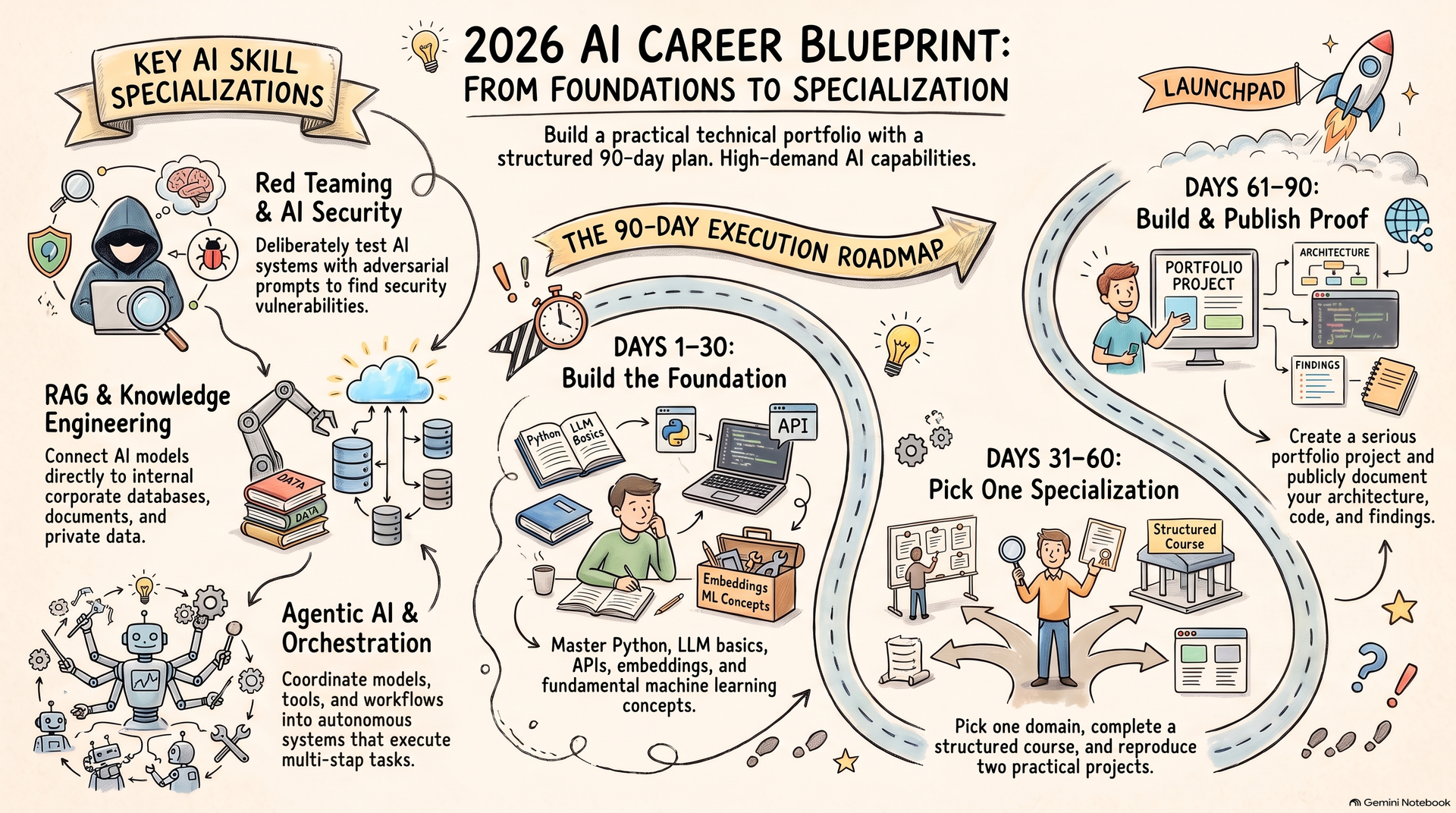
AI is creating a new layer of technical work beyond simply "using ChatGPT."
Companies need people who can connect AI to private data, test models for weaknesses, create useful training data, build autonomous agents and establish systems for responsible AI deployment.
That creates an interesting opportunity for students, developers, analysts and career switchers.
You do not need to learn everything at once. Build the foundation, choose one specialization, then prove the skill through projects.
TL;DR : SCROLL DOWN TO THE BOTTOM OF THE PAGE
Here are six emerging AI skill areas worth exploring in 2026.
1. LLM Red Teaming and AI Security
AI red teaming involves deliberately testing AI systems to discover weaknesses, unsafe behavior, vulnerabilities and ways an attacker could manipulate the system.
It combines AI + cybersecurity + adversarial thinking.
Roadmap
Start with:
Python fundamentals
LLM basics
Prompt injection and jailbreak concepts
AI application security
Threat modelling
Red-team testing and evaluation
Microsoft's free AI Security Fundamentals path covers AI security controls and AI red teaming. Its dedicated AI security testing module also teaches how to plan and execute red-team exercises for LLM applications.
Build this
Create a chatbot and try to break it using adversarial prompts. Document the vulnerabilities, severity and proposed fixes.
That becomes your first portfolio case study.
2. RAG and AI Knowledge Engineering
Most companies do not want an AI that only knows general internet information.
They want AI that understands their documents, policies, products, databases and internal knowledge.
That is where Retrieval-Augmented Generation, or RAG, becomes useful.
Google's free Machine Learning Crash Course now includes embeddings, LLM fundamentals and production ML concepts.
DeepLearning.AI also has a RAG course covering retrieval methods, vector databases, chunking, evaluation and deployment. The first module can be previewed free, while full access is currently part of its paid offering.
Roadmap
Python → embeddings → vector databases → chunking → retrieval → reranking → evaluation → production RAG.
Build this
Create a RAG assistant that answers questions from a company's fictional HR handbook, university regulations or product documentation.
3. AI Training and Domain Expertise
AI systems need more than raw data. They need high-quality examples, evaluations and domain-specific feedback.
This creates opportunities for people who combine AI knowledge with another profession.
A lawyer who understands AI can work on legal AI evaluation.
A finance professional can help evaluate financial outputs.
A medical researcher can contribute domain expertise to healthcare AI projects.
Roadmap
Learn LLM fundamentals → understand evaluation → study supervised fine-tuning concepts → learn preference feedback → specialize in one domain.
Build this
Create 100 domain-specific prompts, define what a good answer looks like, evaluate AI responses and publish your methodology.
Your domain knowledge becomes part of the technical portfolio.
4. Synthetic Data
Sometimes real-world data is scarce, expensive, private or difficult to label.
Synthetic data uses algorithms to generate artificial datasets that can help with development, testing and model training.
Start with statistics, Python, machine learning and data quality.
Google's Machine Learning Crash Course is a useful foundation because it covers datasets, generalization, overfitting, embeddings, neural networks and production ML systems.
Build this
Generate a synthetic customer dataset for an imaginary Indian fintech or D2C company.
Then test whether a model trained on the synthetic data can identify useful patterns without exposing real customer information.
5. AI Governance and Responsible AI
As companies deploy more AI systems, someone has to answer questions such as:
What data can the AI access? Who is accountable? How do we test bias? What happens when the model fails?
That is the territory of AI governance.
Microsoft's free Responsible AI training covers governance systems, principles, safeguards and practical implementation.
Roadmap
Learn AI fundamentals → privacy → security → bias and fairness → transparency → risk assessment → governance frameworks → AI compliance.
Build this
Take a fictional company's AI hiring system and create an AI Governance Playbook covering data access, risk classification, human review, testing, documentation and monitoring.
That is much stronger than simply writing "AI governance" on a resume.
6. Agentic AI and AI Orchestration
This is where AI moves beyond answering questions.
An AI agent can use tools, retrieve information, make decisions and execute multi-step workflows.
AI orchestration is about coordinating models, tools, APIs, memory, workflows and sometimes multiple agents into one functioning system.
The free Hugging Face Agents Course is particularly useful here. It covers agent fundamentals, tools, smolagents, LlamaIndex, LangGraph, Agentic RAG and a final hands-on project.
Roadmap
Python → LLM APIs → tool calling → agents → memory → RAG → workflows → LangGraph/smolagents → evaluation → multi-agent systems.
Build this
Create an AI research agent that receives a business question, searches for information, retrieves relevant sources, analyzes them, creates a report and cites its evidence.
Hugging Face's course even provides hands-on agent projects and a final benchmark-based project.
The 90-Day AI Career Roadmap
Don't attempt six careers simultaneously.
Days 1–30: Foundation
Learn:
Python + LLM fundamentals + APIs + embeddings + basic ML
Use Google's Machine Learning Crash Course and beginner AI resources.
Days 31–60: Specialize
Choose one:
Red teaming
RAG
AI evaluation
Synthetic data
AI governance
Agentic AI
Complete one structured course and reproduce at least two practical projects.
Days 61–90: Build Proof
Create one serious portfolio project.
Then publish:
Problem → Architecture → Tools → Process → Results → Limitations → GitHub/demo
This matters because employers and clients can evaluate what you actually built.
The Real Career Strategy
You don't need to become "an AI expert."
Become the person who understands AI + something valuable.
AI + Cybersecurity
AI + Finance
AI + Healthcare
AI + Law
AI + Marketing
AI + Operations
AI + Data
AI + Governance
That combination is harder to replace than learning another collection of generic prompts.
The opportunity isn't simply to use AI.
It is to understand what happens behind the interface:
Build it. Connect it. Test it. Train it. Govern it. Orchestrate it.
Pick one lane.
Learn the fundamentals.
Build something real.
Then let your portfolio prove the skill.