
Most people ask:
“Which career pays the most?”
That's probably the wrong question.
A better question is:
“Which skill is difficult to find, difficult to replace and directly connected to something valuable?”
That's where compensation starts behaving differently.
A company can find thousands of people who know basic Excel. Thousands who can write generic code. Thousands who can create social media posts. Thousands who have an MBA.
But if a company desperately needs someone who can solve a highly specialized problem and only a handful of people can actually do it well, the economics change.
This is skill scarcity.
And in 2026, AI is accelerating it.
Some skills are becoming easier to automate, while other skills are becoming more valuable because they require a combination of technical depth, judgment, domain expertise, communication, decision-making and real-world execution.
TLDR: SCROLL DOWN TO LOWER LEVEL TO INFOGRAPHIC
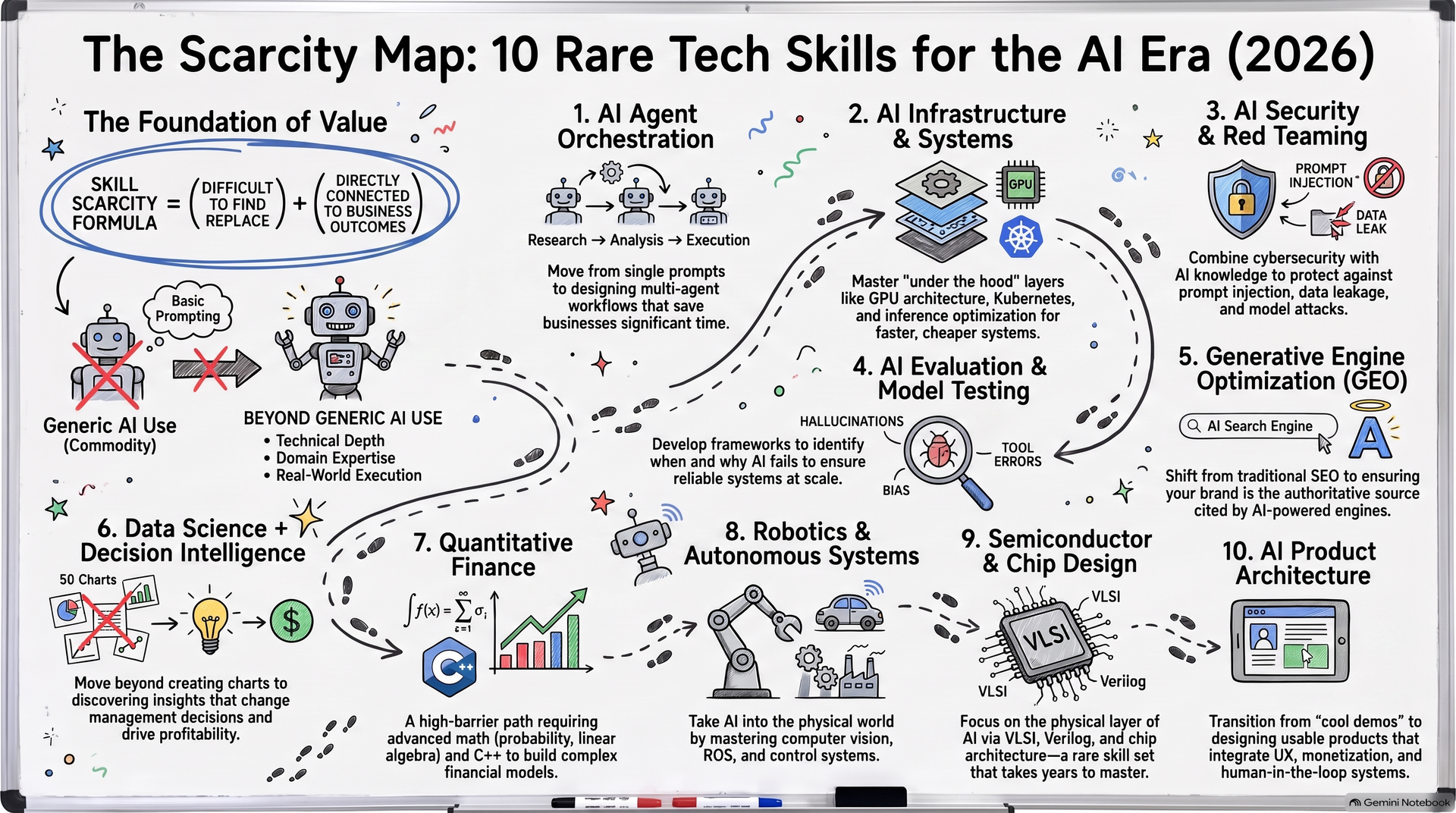
So instead of chasing generic "high-paying jobs," let's look at 20 rare skills across technology and non-technology fields, why they are valuable, and how you can build them.
Part I: 10 Rare Technology Skills
1. AI Agent Orchestration
Prompting AI is becoming a basic skill.
The more valuable capability is designing systems where multiple AI agents, tools and APIs work together to accomplish a larger objective.
For example:
Research → analysis → decision → execution → verification → reporting
Instead of asking AI to complete one task, you're designing an AI-powered workflow.
Roadmap
Stage 1: Master ChatGPT, Claude and Gemini.
Stage 2: Learn structured prompting and context engineering.
Stage 3: Learn automation platforms and APIs.
Stage 4: Learn Python or JavaScript basics.
Stage 5: Build tool-using AI agents.
Stage 6: Build multi-agent workflows around real business problems.
Your portfolio shouldn't be "I built an AI chatbot."
Build something that saves a business 20 hours a week.
That's considerably more valuable.
2. AI Infrastructure and Systems Engineering
Everyone talks about AI applications.
Far fewer people understand the infrastructure underneath them.
Modern AI systems require:
- GPUs
- distributed computing
- inference optimization
- model serving
- data pipelines
- vector databases
- orchestration
- monitoring
- security
As AI adoption grows, companies need engineers who can make these systems faster, cheaper and more reliable.
Roadmap
Start with:
Python → Linux → networking → cloud computing → Docker → Kubernetes
Then learn:
CUDA → GPU architecture → distributed systems → model serving → inference optimization.
Eventually, build and deploy real AI systems rather than simply experimenting with models locally.
This is a difficult path.
That's precisely why it can become valuable.
3. AI Security and AI Red Teaming
AI creates a completely new attack surface.
Organizations need people who understand how AI systems can be manipulated, exploited or abused.
That includes:
- prompt injection
- data leakage
- model abuse
- agent security
- adversarial attacks
- AI supply-chain risks
- privacy vulnerabilities
Roadmap
First learn cybersecurity fundamentals.
Then:
Networking → Linux → web security → Python → cloud security
Move into:
LLM security → AI agents → adversarial testing → model evaluation.
Build a portfolio by ethically testing AI applications and documenting vulnerabilities and mitigations.
The combination of AI + cybersecurity is particularly powerful because you need expertise in both domains.
4. AI Evaluation and Model Testing
There's an emerging problem that doesn't get enough attention:
How do you know an AI system is actually good?
Companies need people who can evaluate whether models and agents:
- hallucinate
- reason correctly
- follow instructions
- produce biased outputs
- use tools correctly
- remain reliable under unusual conditions
Roadmap
Learn:
Statistics → Python → machine learning fundamentals → LLMs
Then study:
benchmarking → evaluation datasets → hallucination testing → red teaming → agent evaluation.
Build evaluation frameworks and publish your findings.
The person who can say:
"This AI system looks impressive, but here are the 17 conditions where it fails."
can become extremely valuable to companies deploying AI at scale.
5. AI Search Optimization / Generative Engine Optimization
Traditional SEO asks:
"How do I appear in Google?"
The emerging question is:
"When someone asks an AI system about my industry, will it mention me?"
This involves understanding how information gets discovered, structured and represented across AI-powered search and answer engines.
Roadmap
Learn traditional SEO first.
Then understand:
- search intent
- topical authority
- structured content
- entity optimization
- digital PR
- citations and mentions
- authoritative sources
Then monitor how AI systems describe your company, products or expertise.
The goal isn't to manipulate AI.
It's to become credible enough that AI has a reason to reference you.
6. Data Science + Decision Intelligence
Data analysts are everywhere.
People who can turn messy data into high-stakes business decisions are much rarer.
Imagine two analysts.
One produces 50 charts.
The other discovers that one customer segment is destroying profitability and explains exactly what management should do.
The second creates far more economic value.
Roadmap
Learn:
Excel → SQL → statistics → Python → visualization
Then develop:
business understanding → experimentation → forecasting → causal reasoning → decision-making.
Your ultimate skill should become:
Data → Insight → Decision → Outcome
That's much more valuable than simply producing dashboards.
7. Quantitative Finance / Algorithmic Trading
This is one of the most difficult technical paths on the list.
Quantitative finance combines:
- mathematics
- probability
- statistics
- programming
- financial markets
- optimization
- decision-making
High-frequency trading is an extreme example.
Roadmap
Build strong foundations in:
Probability → statistics → calculus → linear algebra → algorithms
Then:
Python → C++ → financial mathematics → market microstructure → quantitative modelling.
Don't start by trying to build a trading bot with $10,000.
Start by understanding the mathematics.
The barrier to entry is high.
That is also the point.
8. Robotics and Autonomous Systems
AI isn't going to remain confined to screens.
It is increasingly moving into:
- factories
- warehouses
- vehicles
- agriculture
- healthcare
- defence
- logistics
Robotics combines software with the physical world.
Roadmap
Learn:
Python → C++ → mathematics → physics → control systems
Then study:
computer vision → ROS → sensors → robotics algorithms → reinforcement learning.
Build physical projects.
A robot that actually navigates a room is far more valuable as a portfolio project than another generic AI website.
9. Semiconductor / Chip Design
AI's explosion depends on something very physical:
chips.
The semiconductor industry requires expertise in areas such as:
- digital design
- verification
- VLSI
- semiconductor physics
- chip architecture
- fabrication
- packaging
Roadmap
Start with:
electronics → digital logic → computer architecture
Then specialize into:
VLSI → RTL → Verilog/SystemVerilog → verification → physical design
Eventually work on real chip projects.
This isn't a weekend skill.
It can take years.
But that's exactly why expertise can become scarce.
10. AI Product Architecture
There is a huge difference between:
building an AI demo
and
building an AI product people actually use.
AI product architects understand technology, users, economics and business processes simultaneously.
Roadmap
Learn:
product management → UX → APIs → databases → AI fundamentals
Then learn to design:
AI workflows → evaluation → monetization → analytics → human-in-the-loop systems.
Build products that solve real problems.
The ultimate test:
Will someone pay for it?
Part II: 10 Rare Non-Tech Skills
Now here's where things become interesting.
High-value scarcity isn't limited to software.
Some of the most difficult problems facing humanity are physical, scientific, environmental and organizational.
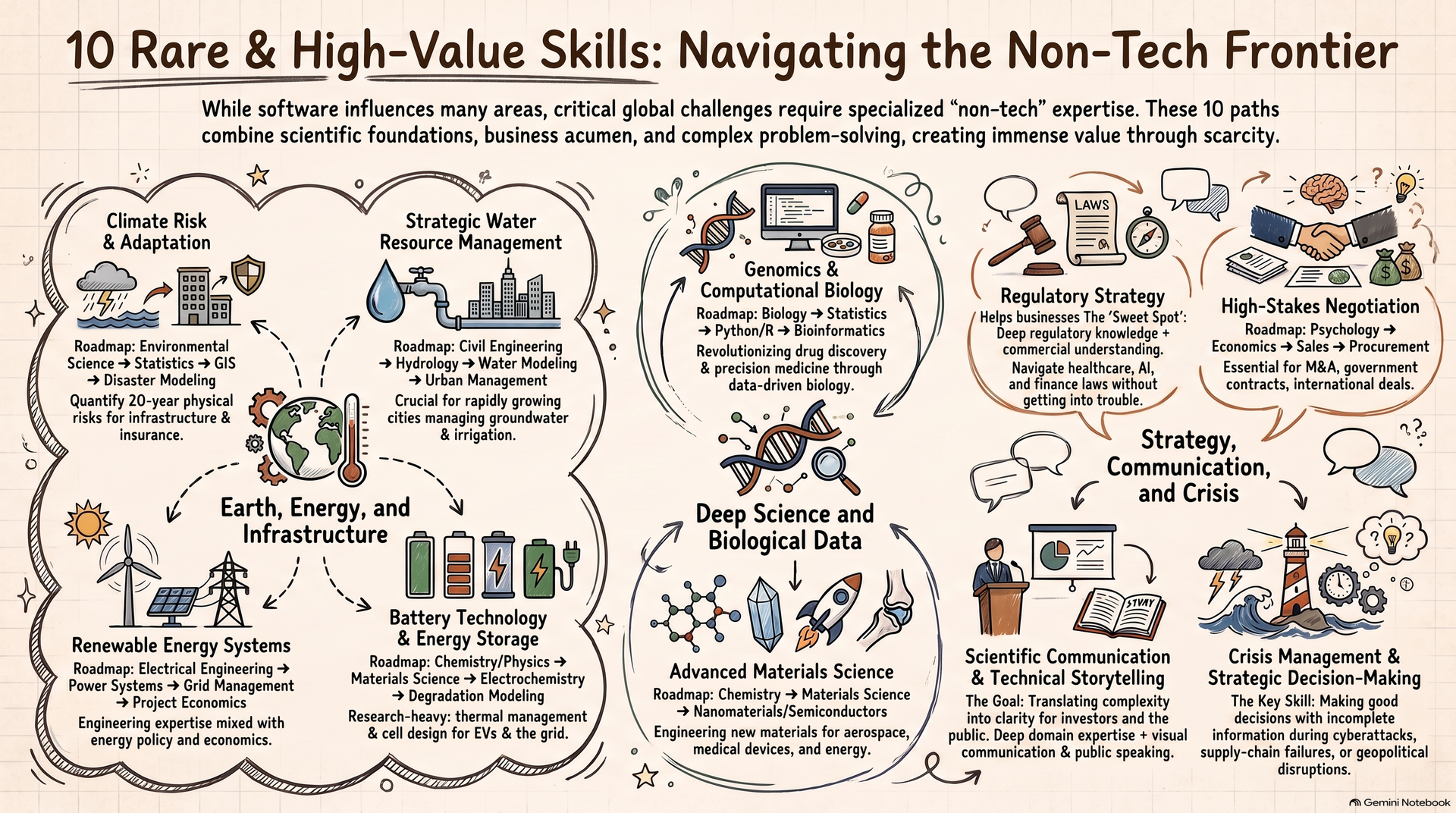
TLDR - SCROLL DOWN TO THE INFOGRAPHIC TO UNDERSTAND QUICKLY.
11. Climate Risk and Adaptation
Climate change is increasingly becoming a business, infrastructure and insurance problem.
Organizations need people who understand:
- climate modelling
- physical risks
- adaptation
- resilience
- infrastructure planning
- environmental policy
Roadmap
Start with:
environmental science → climate science → statistics
Then specialize in:
climate risk assessment → GIS → disaster modelling → adaptation planning.
Combine scientific knowledge with business understanding.
Someone who can tell a company:
"Here's how climate risk could affect your operations over the next 20 years and what you should do about it"
possesses a highly specialized skill.
12. Water Resource Management
Water is one of the world's most strategically important resources.
Managing it involves:
- hydrology
- groundwater
- irrigation
- urban water systems
- climate modelling
- environmental policy
Roadmap
Study:
civil/environmental engineering → hydrology → GIS → water modelling
Then specialize in:
urban water management, groundwater systems or climate-resilient infrastructure.
This is particularly relevant for rapidly growing cities.
13. Renewable Energy Systems
The energy transition isn't simply about installing solar panels.
The difficult problems involve:
- grid integration
- energy storage
- power systems
- forecasting
- transmission
- renewable project planning
Roadmap
Start with:
electrical engineering → power systems → renewable energy
Then learn:
battery systems → grid management → energy modelling → project economics.
The rare combination is engineering + economics + energy policy.
14. Battery Technology and Energy Storage
Electric vehicles and renewable energy have created enormous demand for better storage.
Important areas include:
- battery chemistry
- materials science
- degradation
- thermal management
- battery management systems
- recycling
Roadmap
Build foundations in:
chemistry → physics → materials science
Then specialize in:
electrochemistry → battery materials → cell design → testing → degradation modelling.
This is a research-heavy path, but expertise can be extraordinarily valuable.
15. Genomics and Computational Biology
Biology is becoming increasingly data-driven.
The intersection of:
biology + computation + statistics
is producing powerful applications in medicine, agriculture and biotechnology.
Roadmap
Learn:
biology → genetics → statistics
Then:
Python/R → bioinformatics → genomics → computational biology.
Eventually specialize in areas such as:
drug discovery, population genomics or precision medicine.
This is another field where interdisciplinary expertise creates scarcity.
16. Advanced Materials Science
The next generation of technology depends heavily on materials.
Think:
- semiconductors
- batteries
- aerospace
- energy
- medical devices
- construction
The person who discovers or engineers a material with dramatically better properties can create enormous value.
Roadmap
Study:
chemistry → physics → materials science
Then specialize in:
nanomaterials → polymers → semiconductor materials → energy materials
depending on your interests.
This is a long-term research career, not a quick salary hack.
17. Regulatory Strategy
Here's a surprisingly valuable skill:
Understanding complicated regulations well enough to help businesses navigate them.
This matters enormously in:
- healthcare
- pharmaceuticals
- finance
- AI
- energy
- aviation
- food
- environmental industries
Roadmap
Choose an industry.
Then develop expertise in:
regulation → compliance → policy → risk → business operations.
The sweet spot is:
deep regulatory knowledge + commercial understanding.
You become the person who can tell a company:
"Here's what you're allowed to do, here's what will get you into trouble and here's how we can structure this legally."
That's valuable.
18. High-Stakes Negotiation
Negotiation exists in almost every industry.
But high-stakes negotiation is a different game.
Think:
- mergers
- acquisitions
- government contracts
- enterprise sales
- labour agreements
- international deals
- strategic partnerships
Roadmap
Learn:
negotiation theory → psychology → economics → communication
Then practise through:
sales → procurement → contracts → partnerships.
The next step is learning the industry you're negotiating in.
A negotiator who understands technology, finance and law simultaneously becomes much harder to replace.
19. Scientific Communication and Technical Storytelling
Scientists often know extraordinary things.
But many struggle to explain those things to:
- governments
- investors
- journalists
- customers
- the public
That creates a fascinating opportunity.
Someone who understands complex science and can communicate it clearly can become incredibly valuable.
Roadmap
Develop expertise in a scientific domain.
Then deliberately learn:
writing → visual communication → presentation → storytelling → public speaking.
Don't dumb down the science.
Make it understandable.
The ability to translate complexity into clarity is increasingly valuable.
20. Crisis Management and Strategic Decision-Making
Some decisions matter enormously when things go wrong.
Think:
- natural disasters
- cyberattacks
- supply-chain failures
- corporate crises
- geopolitical disruptions
- infrastructure failures
The people handling these situations need calm judgment under uncertainty.
Roadmap
Learn:
risk management → scenario planning → decision theory → communication
Then develop domain expertise.
Practise simulations and crisis exercises.
The key skill isn't predicting everything.
It's being able to make good decisions when you don't have complete information.
The Bigger Pattern
Notice something about these 20 skills.
Most aren't valuable simply because they're difficult.
They're valuable because they sit at the intersection of scarcity + consequence + complexity.
A useful mental model is:
High income potential = Scarcity × Value of problem × Difficulty of replacement
If 100,000 people can do something reasonably well, companies have bargaining power.
If only 100 people can solve a highly expensive problem, the bargaining power begins shifting toward the talent.
That's why you shouldn't simply ask:
"What skill should I learn?"
Ask:
"What expensive problem could I become unusually good at solving?"
Your Skill-Scarcity Roadmap
Don't try to learn all 20.
Pick one primary skill and one complementary skill.
For example:
AI + Finance
AI orchestration + quantitative finance
AI + Healthcare
AI systems + genomics
Energy + Data
Renewable energy + data science
Environment + Technology
Climate risk + AI
Business + Psychology
Negotiation + behavioural science
Science + Communication
Materials science + scientific storytelling
That's where things get interesting.
Because the future may not reward the person who knows one thing extremely well.
It may reward the person who combines two difficult disciplines unusually well.
The 5-Year Strategy
Year 1: Foundation
Learn the fundamentals.
Take courses.
Read deeply.
Build small projects.
Year 2: Specialization
Pick a narrow problem.
Go deeper than the average professional.
Year 3: Proof
Build a portfolio.
Publish research.
Work on real projects.
Get measurable outcomes.
Year 4: Reputation
Become known for that problem.
Speak.
Write.
Network.
Collaborate.
Year 5: Leverage
Move from:
Employee → Specialist → Consultant → Builder → Owner
The final stage is important.
The highest economic upside doesn't necessarily come from having the rarest skill.
It comes from owning the system that uses that rare skill.
The Real Secret Behind High-Income Skills
Don't chase a salary.
Chase scarcity.
Don't chase a job title.
Chase expensive problems.
Don't collect certificates.
Build proof.
And don't stop at learning.
Turn:
Skill → Proof → Outcome → Reputation → Opportunity → Income → Ownership
That's the real roadmap.
Because the person who can solve a problem that very few people can solve has leverage.
And the person who can solve that problem and build a business around it has even more.
The future isn't going to be divided simply into "tech jobs" and "non-tech jobs."
It will increasingly be divided between people who are easy to replace and people who have become exceptionally valuable at solving problems that matter.
So if you're choosing your next skill in 2026, don't ask:
"What is trending?"
Ask the harder question:
"What could I become exceptionally good at that the market will struggle to find?"
That's where skill scarcity becomes career leverage.