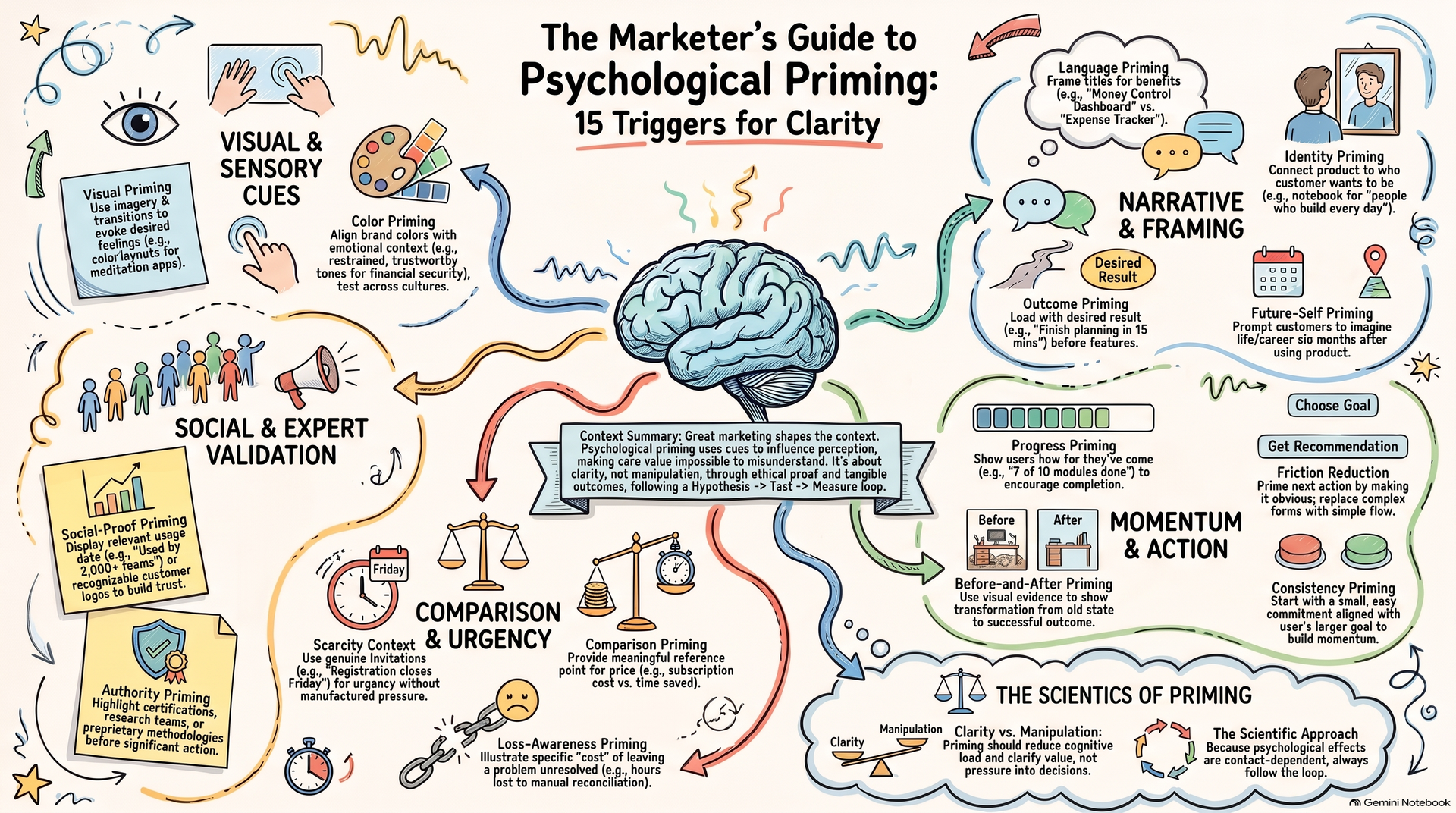
Great marketing doesn't only explain what a product does. It shapes the context in which people experience it.
This is where psychological priming becomes interesting. Priming broadly refers to situations where exposure to one cue can influence how people subsequently perceive, interpret or respond to something. In product marketing, that can mean using language, visuals, social context, interface design and experiences to make a product's value easier to recognize.
TLDR; SCROLL DOWN TO THE BOTTOM of THE Page
Here are 15 practical priming triggers marketers and founders can test.
1. Visual Priming
Trigger: Use visual cues associated with the desired feeling.
Example: A meditation app can use calm imagery, spacious layouts and gentle visual transitions to establish a relaxation-oriented context.
2. Color Priming
Trigger: Use colors consistently with the emotional context of the brand.
Example: A financial-security product might use restrained, trustworthy visual language rather than chaotic, aggressive colors.
Tip: Color effects depend heavily on culture, context and individual interpretation. Test rather than assume.
3. Language Priming
Trigger: Words can frame how people interpret an experience.
Example: Instead of “expense tracker,” position a product as a “money control dashboard.”
The second phrase primes users to think about control rather than restriction.
4. Outcome Priming
Trigger: Show the desired result before explaining the features.
Example: A productivity tool opens its landing page with:
“Finish your weekly planning in 15 minutes.”
Then explain how the product achieves it.
5. Social-Proof Priming
Trigger: Show that relevant people already use the product.
Example: A B2B SaaS product could highlight:
“Used by 2,000+ marketing teams.”
Even better, show recognizable customer examples when you have permission.
6. Authority Priming
Trigger: Establish credible expertise before asking for action.
Example: A cybersecurity company can introduce its research team, certifications and security methodology before presenting its product.
7. Identity Priming
Trigger: Connect the product with the identity customers want to build.
Example: Instead of selling a notebook as stationery, position it as:
“For people who build every day.”
You're selling an identity alongside the product.
8. Progress Priming
Trigger: Make progress visible.
Example: A learning platform shows:
“7 of 10 modules completed.”
The user sees themselves as someone already progressing, encouraging continued engagement.
9. Scarcity Context
Trigger: Communicate genuine limitations when they actually exist.
Example:
“Registration closes Friday.”
This creates urgency without manufacturing fake scarcity.
10. Loss-Awareness Priming
Trigger: Explain the cost of leaving a problem unresolved.
Example: An accounting product could show:
“Manual reconciliation can consume hours every month.”
Then demonstrate how the product reduces that workload.
11. Comparison Priming
Trigger: Give customers a meaningful reference point.
Example: Instead of simply saying a subscription costs ₹999/month, show what that represents compared with the time or cost of the alternative.
12. Friction Reduction
Trigger: Prime action by making the next step extremely obvious.
Example: Replace a complicated signup sequence with:
“Start free → Choose goal → Get recommendation.”
Less cognitive friction can make the intended action easier.
13. Future-Self Priming
Trigger: Help customers imagine the result after using the product.
Example: A career platform might ask:
“What could your career look like six months from now?”
Then connect the answer to the product's roadmap.
14. Before-and-After Priming
Trigger: Make transformation visually obvious.
Example: A design agency can show:
Old website → Redesigned website → Business outcome
This gives the customer a concrete mental model of the transformation.
15. Consistency Priming
Trigger: Start with a small action that naturally connects to the larger goal.
Example: A fitness app asks users to select one weekly goal first. The subsequent experience is built around that commitment.
How to Use Priming Without Becoming Manipulative
The strongest marketing isn't about secretly controlling someone's mind.
It's about making the value proposition easier to understand and the customer's decision easier to navigate.
Use these triggers to:
- Clarify your product's value
- Reduce unnecessary cognitive load
- Demonstrate genuine proof
- Create relevant context
- Make outcomes tangible
- Improve customer experience
Don't use them to create fake scarcity, misleading claims or pressure people into decisions they wouldn't otherwise make.
And remember: psychological effects are context-dependent. A trigger that works for one audience may fail completely for another.
That's why the smartest approach is:
Hypothesis → Test → Measure → Improve.
Your landing-page headline, colors, CTA, social proof, onboarding sequence and product experience can all be tested.
The goal isn't to make your product irresistible through psychological tricks.
The goal is to make its real value impossible to misunderstand.
ROADMAP INFOGRAPHIC