Stop Saying You're Skilled. Start Showing It.
For years, the traditional career formula was simple.
Get a degree → Make a resume → Apply for jobs → Hope someone gives you a chance.
That formula still exists. But the internet has created another path.
Today, a designer can show their designs on Instagram. A developer can publish projects on GitHub. A marketer can document campaign results on LinkedIn. A writer can publish articles. A student can build projects before getting their first job.
And sometimes, your work itself can become your resume.
A recent example is Surendra Singh Choudhary, popularly known online as Bittu Tabahi, whose efforts to clean the polluted Ajnar River in Madhya Pradesh gained widespread attention online. His documented work and before-and-after transformation eventually caught the attention of Boyan Slat, founder of The Ocean Cleanup, who publicly invited him to work with the organisation.
The lesson is bigger than one viral story.
People cannot evaluate skills they cannot see.
That is why building a strong portfolio and personal brand is becoming increasingly important for students, freelancers, professionals and aspiring founders.
Here is a practical roadmap.
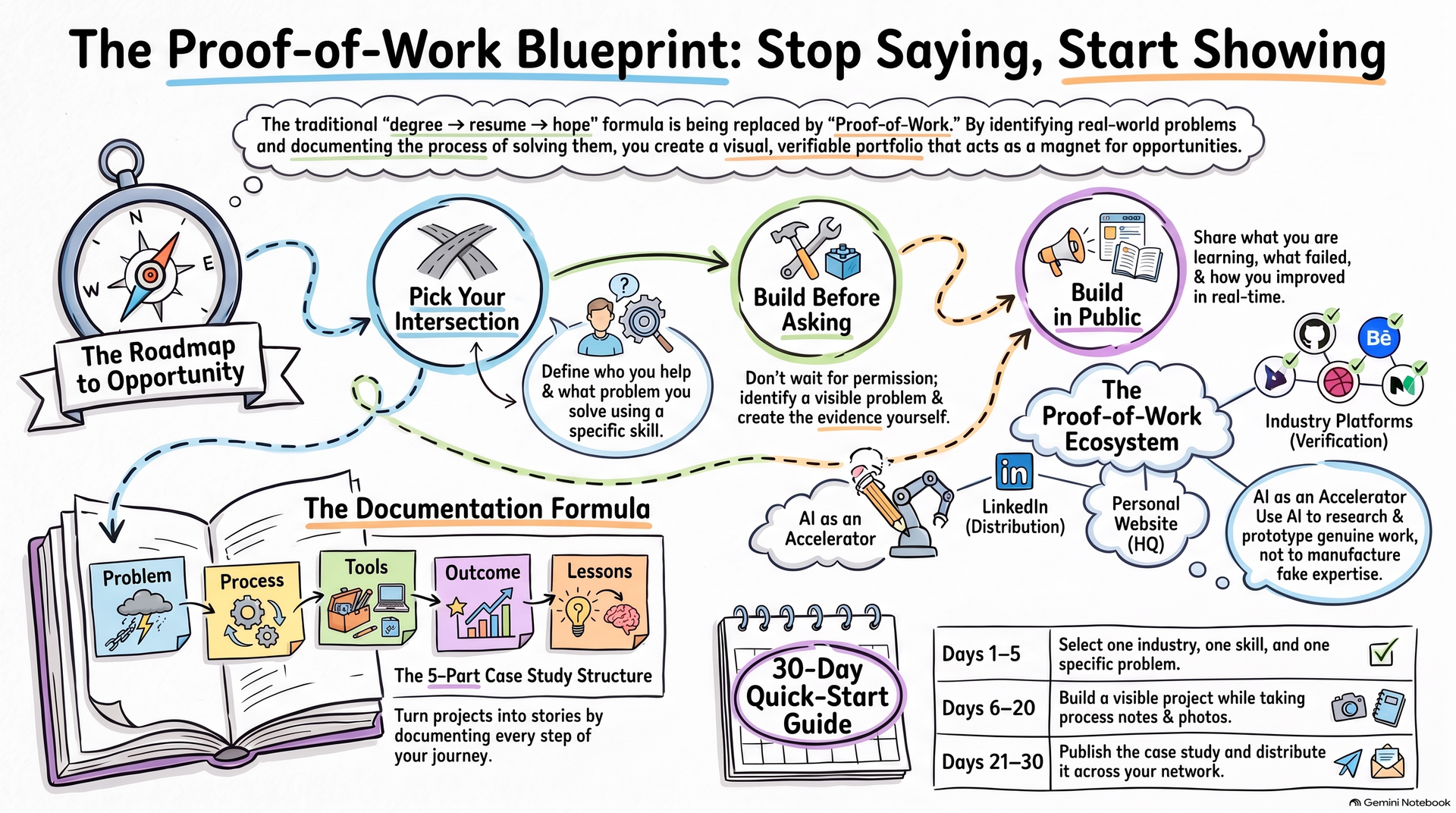
TLDR: SCROLL DOWN TO SEE THE INFOGRAPHIC
Step 1: Pick the Industry You Want to Be Known In
The biggest mistake people make when building a personal brand is trying to talk about everything.
Don't become:
“A person interested in business, AI, marketing, finance, technology and self-improvement.”
That's too broad.
Instead, start with one intersection:
Who do you want to help?
What problem do you want to solve?
What industry do you want opportunities from?
For example:
- AI automation for small businesses
- Content marketing for startups
- UX design for fintech companies
- Data analysis for healthcare
- Sustainability and environmental projects
- Cybersecurity for small businesses
- Product design for education companies
Your goal is to create a simple positioning statement:
I help [specific audience] solve [specific problem] using [your skill].
For example:
“I help local businesses automate repetitive customer workflows using AI.”
That immediately gives your portfolio direction.
Step 2: Build Something Before Asking for an Opportunity
You don't always need permission to start.
Bittu's story demonstrates a powerful principle: identify a visible problem and take meaningful action.
He didn't begin with a polished environmental resume.
His work became the evidence.
You can apply the same idea to almost any industry.
If you're a marketer:
Don't just say you understand marketing.
Create a growth strategy for a real or imaginary business.
If you're a designer:
Redesign a confusing app experience and explain your decisions.
If you're a developer:
Build and deploy a useful application.
If you're interested in AI:
Create an AI workflow that solves a genuine business problem.
If you're interested in finance:
Analyze a public company and publish your research.
The principle is simple:
Don't wait for work to build your portfolio. Build work to create your opportunity.
Step 3: Document the Journey, Not Just the Final Result
This is one of the biggest lessons from modern creator-led careers.
People don't only want to see the finished product.
They want to understand:
- What problem did you find?
- Why did you decide to solve it?
- What did the situation look like before?
- What actions did you take?
- What challenges did you face?
- What changed?
- What did you learn?
This creates something far more powerful than a certificate.
It creates a story backed by evidence.
Bittu's work gained attention partly because visual documentation made the transformation easy to understand. Before-and-after images and videos gave people a way to see the impact rather than simply being told about it.
That principle works across industries.
A strong proof-of-work portfolio should include:
1. The Problem
What was broken?
2. Your Process
What did you actually do?
3. Your Tools
What skills, software or methods did you use?
4. The Outcome
What changed because of your work?
5. The Lesson
What would you improve next time?
This structure turns random projects into professional case studies.
Step 4: Use the Proof-of-Work Stack
In 2026, your portfolio does not need to live on one website.
Build a small ecosystem.
Your Personal Website: Your Digital Headquarters
Create a simple portfolio website containing:
- Your introduction
- Your positioning
- Your best projects
- Case studies
- Testimonials
- Contact information
Tools such as Notion, Framer, Webflow and AI-assisted website builders have made this significantly easier.
But remember:
A beautiful website without proof is still just decoration.
LinkedIn: Your Professional Distribution Channel
Use LinkedIn to document:
- Projects
- Case studies
- Lessons
- Industry opinions
- Behind-the-scenes work
Instead of posting:
“Happy to announce that I completed another course.”
Try posting:
“I used what I learned to solve this problem. Here's what happened.”
The second post demonstrates capability.
Instagram or YouTube: Your Storytelling Channel
Visual platforms are particularly useful when your work can be documented through transformation.
For example:
Before → Process → After
This format works for:
- Designers
- Builders
- Creators
- Fitness professionals
- Environmental projects
- Artists
- Entrepreneurs
- Marketers
The internet rewards visible transformation.
So don't just show the destination.
Show the journey.
GitHub, Behance or Industry Platforms
Choose platforms relevant to your profession.
For example:
- Developers → GitHub
- Designers → Behance
- Writers → Medium or personal blog
- Researchers → Google Scholar or relevant repositories
- Photographers → Visual portfolio
- Marketers → Case study website
Make it easy for someone to verify your work.
A useful modern portfolio often combines working projects, live demos, repositories, case studies and measurable outcomes, rather than simply listing skills on a resume.
Step 5: Build in Public
One of the most effective modern personal-branding strategies is building in public.
This means documenting selected parts of your journey while you are still learning and building.
You don't need to pretend to be an expert.
You can simply share:
“Here's what I'm learning.”
“Here's what I tried.”
“Here's what failed.”
“Here's how I improved it.”
For example, imagine you're learning AI automation.
Your content could become:
Week 1:
I built my first automated workflow.
Week 2:
Here are three mistakes I made.
Week 3:
I automated this task for a local business.
Week 4:
Here is the before-and-after workflow.
Within a few months, you haven't just learned AI automation.
You've created:
Skills + Projects + Content + Portfolio + Personal Brand
That is leverage.
Step 6: Use AI to Strengthen Your Proof, Not Fake It
AI can help you build faster.
Use it to:
- Research industries
- Brainstorm projects
- Improve documentation
- Analyze data
- Build prototypes
- Create portfolio websites
- Turn projects into case studies
- Repurpose your work into content
But there is an important rule.
Don't use AI to manufacture fake expertise.
Use AI to accelerate genuine work.
A strong AI-era portfolio can also document the workflow itself: the original problem, the process, AI tools used, human review and the final result. That gives employers evidence that you can use AI responsibly rather than simply generate outputs.
A Simple 30-Day Proof-of-Work Roadmap
Days 1 to 5: Choose Your Direction
Pick:
- One industry
- One skill
- One problem
Avoid trying to build everything at once.
Days 6 to 15: Build Your First Project
Create something that solves a real problem.
It doesn't need to be perfect.
It needs to be visible.
Days 16 to 20: Document Everything
Create:
- Photos
- Screenshots
- Videos
- Process notes
- Before-and-after comparisons
Days 21 to 25: Publish Your Case Study
Explain:
Problem → Action → Process → Result → Lesson
Days 26 to 30: Distribute the Story
Share it on:
- YouTube
- X
- Your portfolio website
One project can become multiple pieces of content.
The Future Resume Is Already Being Built Online
Your resume says:
“I can do this.”
Your portfolio says:
“Here. I already did it.”
That difference matters.
The best personal brands of the future may not belong to people who simply talk the loudest about their skills.
They may belong to people who consistently create visible evidence of their work.
Bittu Tabahi's story is a reminder of that principle.
His work was visible.
His journey was documented.
The transformation was easy for people to understand.
And the proof travelled further than a traditional resume ever could.
So don't wait until someone hires you before doing meaningful work.
Find a problem.
Build something.
Document the process.
Show the result.
Then let your proof speak before your resume does.